AntsRoute vs Urbantz: which alternative should you choose for your route planning in 2026?
Blog > Route optimisation > AntsRoute vs Urbantz: which alternative should you choose for your route planning in 2026?
AntsRoute vs Urbantz: which alternative should you choose for your route planning in 2026?
Published on 7 May 2026 • Reading time: 10 min read
With last-mile delivery challenges continuing to grow, choosing the right route management software is no longer just a competitive advantage — it has become a real performance driver. Reducing costs, improving punctuality and enhancing customer satisfaction are now top priorities, and businesses need tools that can keep pace.
In this context, AntsRoute stands out as a particularly relevant solution for businesses looking to optimise their route planning efficiently while simplifying day-to-day operations for field teams. Thanks to its advanced optimisation engine, quick onboarding and operations-focused approach, the platform enables organisations to improve efficiency rapidly without the need for a complex IT project.
Meanwhile, Urbantz primarily targets retail and e-commerce businesses working with multiple external carriers. The platform is more heavily focused on logistics flow orchestration and multi-carrier coordination.
So, which solution truly matches your needs in 2026? Let’s take a closer look together!
Table of contents:
- AntsRoute vs Urbantz: two approaches to last-mile delivery
- AntsRoute vs Urbantz: comparing the features
- AntsRoute vs Urbantz: where does the real difference lie?
- Why is AntsRoute a strong alternative to Urbantz?
AntsRoute vs Urbantz: two approaches to last-mile delivery
Before even comparing features, it’s important to understand one thing: AntsRoute and Urbantz are not designed to address the same needs.
Urbantz: multi-carrier logistics orchestration
Founded in 2014 in Brussels, Urbantz was designed to centralise and coordinate delivery operations involving multiple external carriers.
The platform is primarily aimed at large retailers, marketplaces and e-commerce businesses managing very high delivery volumes and complex carrier networks.
☝️ In practical terms, Urbantz enables businesses to centralise the management of their logistics partners and monitor all delivery flows from a single interface.
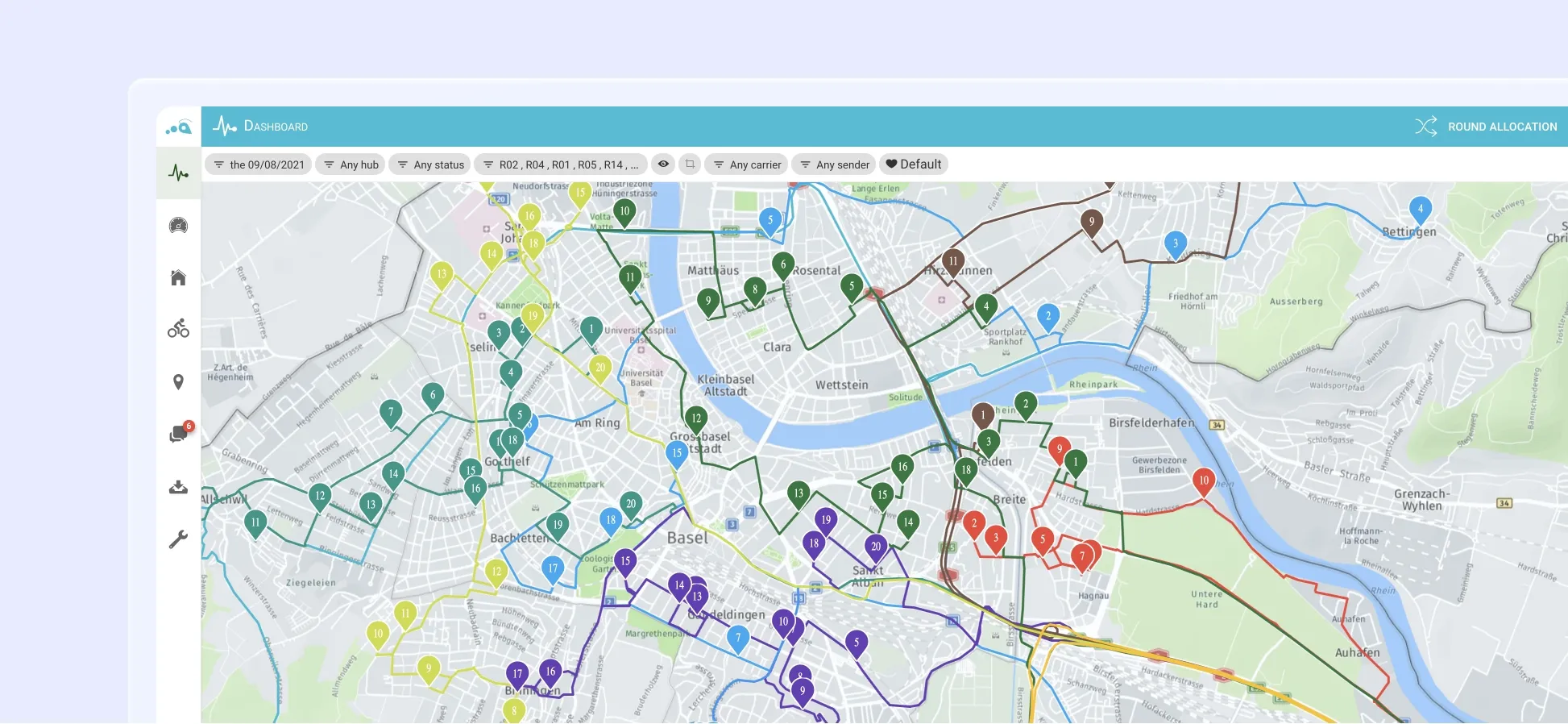
Urbantz dashboard showing delivery routes and stop points around Basel.
AntsRoute: agility built for field operations
Meanwhile, AntsRoute takes a far more direct approach. Developed by the French company Antsway, this SaaS route optimisation software was designed to answer a simple question: how can businesses optimise routes in an advanced way while keeping the platform simple and quick to use on a daily basis?
Here, the focus is firmly on operations. AntsRoute does more than just manage deliveries — it also takes into account the day-to-day realities faced by field teams, particularly when it comes to technical interventions and home services.
The solution is therefore designed for several industries:
- Last-mile delivery (parcels, furniture, fresh produce, fuel deliveries, etc.)
- On-site jobs (maintenance, installation, repairs, after-sales service, etc.)
- Home healthcare services (laboratories, hospital-at-home providers, home care providers, physiotherapists, personal care services, etc.)
Unlike platforms primarily focused on logistics orchestration, AntsRoute places the emphasis on operational route optimisation.
The solution is built to natively handle a wide range of business-specific constraints:
- time windows,
- vehicle capacities,
- agent skill sets,
- geographical service areas,
- service durations,
- route balancing, and more.
All of this is delivered through an intuitive interface that enables teams to become self-sufficient quickly.
Designed for SMEs as well as field service teams, AntsRoute makes it easy to plan and optimise routes while automating a wide range of operational tasks, including agent assignment, customer notifications, service reports and real-time tracking.
☝️ The objective is clear: save time, reduce mileage and simplify day-to-day operations for field teams.
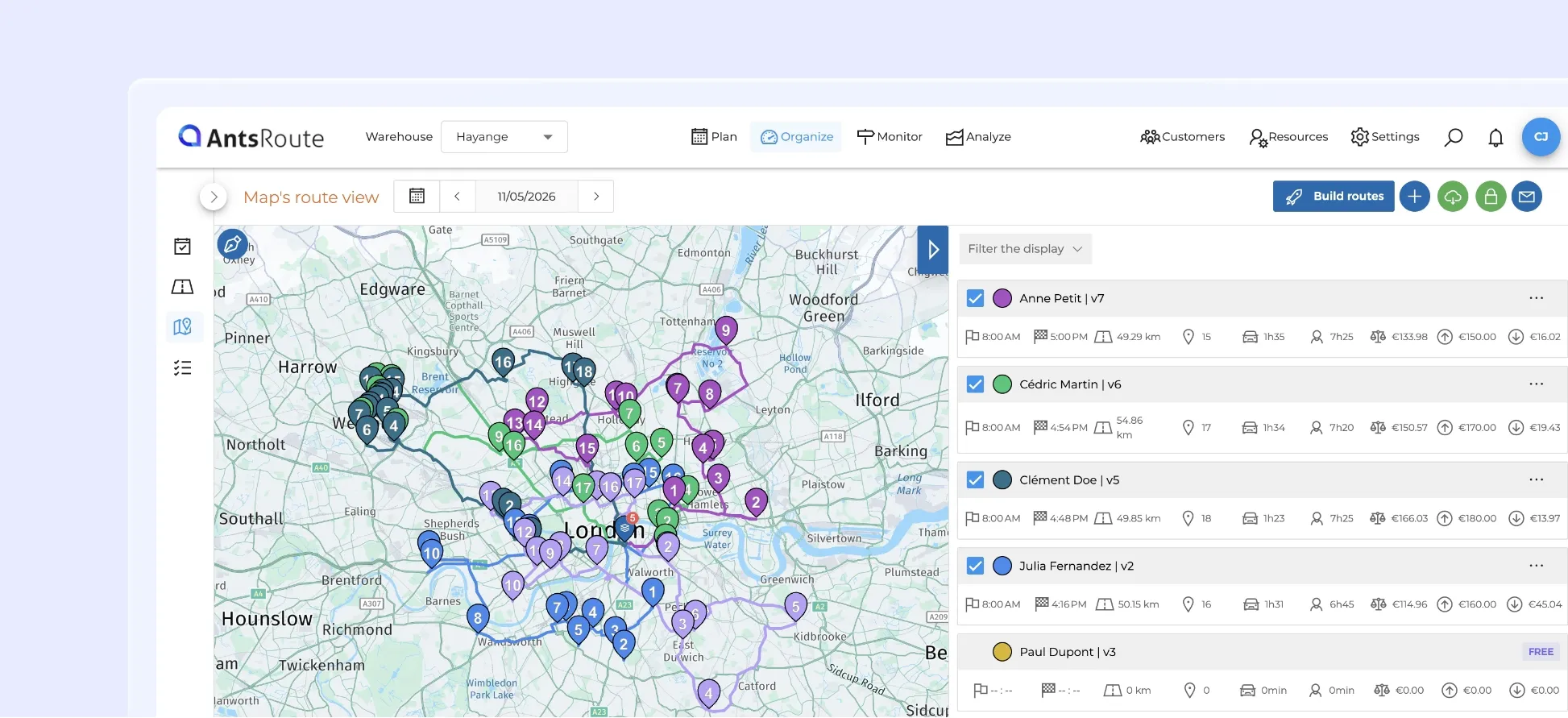
Visualisation of optimised routes and driver itineraries in AntsRoute.
AntsRoute vs Urbantz: comparing the features
To give you a clearer overview at a glance, here’s how the two solutions compare:
1. Positioning and target market
| Features | AntsRoute | Urbantz |
| Positioning | Route optimisation + field jobs | Multi-carrier orchestration |
| Target market | Mid-sized companies, SMEs, small businesses and field teams (technicians, drivers, healthcare professionals) | Retailers, e-commerce businesses and large enterprises |
| Logistics model | In-house fleet | In-house fleet + external carriers (3PL) |
| Main use case | Delivery + maintenance + field services | Large-scale e-commerce delivery |
2. Route planning and optimisation
| Features | AntsRoute | Urbantz |
| Automatic optimisation | Advanced, native and fast | Advanced (often via API or business rules) |
| Constraint management (time slots, capacities, etc.) | Highly advanced and intuitive | Highly advanced |
| Dynamic rescheduling | ✅ Yes | ✅ Yes |
| Time slot management | Dynamic | Dynamic |
| Integration of external routes | Limited | Available |
AntsRoute stands out with its highly advanced optimisation engine, capable of efficiently handling complex field constraints while remaining simple to configure and quick to operate.
Like AntsRoute, Urbantz enables businesses to manage a wide range of delivery operations, although with an approach more heavily focused on coordinating multiple external carriers.
3. Fleet and resource management
| Features | AntsRoute | Urbantz |
| Managed fleets | Primarily internal fleet | Internal fleet + third-party carriers (3PLs) |
| Multi-carrier support | ✅ Yes | ✅ Yes |
| Multi-depot management | ✅ Yes | ✅ Yes |
| Team management | ✅ Yes | ✅ Yes |
| Route balancing | ✅ Yes | ✅ Yes |
4. Mobile and field application
| Features | AntsRoute | Urbantz |
| Mobile application | Very comprehensive | Comprehensive |
| Built-in navigation | Yes (Waze, Google Maps) | Yes (Waze, Google Maps) |
| GPS tracking | ✅ Yes | ✅ Yes |
| Add/edit jobs | Easy | More limited |
| Real-time synchronisation | ✅ Yes | ✅ Yes |
Both platforms offer a comprehensive mobile experience, although AntsRoute clearly stands out for its ease of day-to-day use for field teams.
5. Delivery tracking and customer experience
| Features | AntsRoute | Urbantz |
| ETA (estimated time) | ✅ Yes | ✅ Yes |
| Customer notifications | SMS/e-mail | SMS/e-mail/WhatsApp |
| Proof of delivery | Signature, photos, scanning, comments | Signature, scanning, validation |
| Time slot selection | Advanced | Advanced |
| Live tracking | ✅ Yes | ✅ Yes |
| Cash on delivery payment | ❌ No | ✅ Yes |
Both solutions offer customisation options, with AntsRoute effectively covering operational needs such as customer notifications, while Urbantz provides more extensive customisation capabilities for e-commerce projects.
6. Integrations & API
| Features | AntsRoute | Urbantz |
| API | ✅ Yes | ✅ Yes |
| CRM/ERP integration | ✅ Yes | ✅ Yes |
| Customisation | Advanced | Advanced |
| Workflow automation | Advanced | Advanced |
| Ease of integration | High | Standard |
7. Reporting & performance management
| Features | AntsRoute | Urbantz |
| Dashboards | ✅ Yes | ✅ Yes |
| Performance tracking | ✅ Yes | ✅ Yes |
| Cost/route analysis | ✅ Yes | ✅ Yes |
| Custom KPIs | ✅ Yes | ✅ Yes |
| Data utilisation | Advanced | Advanced |
Both solutions provide comprehensive management and reporting tools with broadly similar KPIs, but the difference lies in data accessibility, which is more intuitive with AntsRoute.
8. Support & documentation
| Features | AntsRoute | Urbantz |
| Help centre | AntsRoute support | Urbantz support |
| Focus | User/business-oriented | Technical/integration-oriented |
| Ease of use | Very easy | Complicated |
| API documentation | Comprehensive | Comprehensive |
| Ease of implementation | Fast (turnkey SaaS solution) | Longer implementation time |
AntsRoute stands out for its fast onboarding and user-focused experience, whereas Urbantz generally requires a greater level of technical support and implementation assistance.
9. Pricing
| Features | AntsRoute | Urbantz |
| Pricing | Transparent (from €34/vehicle/month) | Quote-based pricing (designed for high-volume operations) |
| Free trial | ✅ Yes | ❌ No |
| Demo | ✅ Yes | ✅ Yes |
10. Overall summary
| Key feature | AntsRoute | Urbantz |
| Ease of use | ⭐️⭐️⭐️⭐️ | ⭐️⭐️ |
| Functional power | ⭐️⭐️⭐️⭐️ | ⭐️⭐️⭐️⭐️ |
| Deployment | Fast | Average |
| Field adaptability | Excellent | Average |
☝️ Both solutions cover the core features required for route management. The main difference lies in their target audience and overall user experience.
Quick overview
| If you are looking for… | Choose |
| Optimise field operations routes with ease | AntsRoute |
| Manage a logistics network dedicated to retail | Urbantz |
| A tool that is quick to deploy | AntsRoute |
AntsRoute vs Urbantz: where does the real difference lie?
You now have a clear overview of the features offered by each solution. But beyond these similarities, one thing becomes clear: AntsRoute and Urbantz share the same objective — optimising delivery operations — without following the same approach.
Here are the main areas that set them apart.
1. Parcel delivery or service management?
This is probably the most visible difference.
Urbantz is particularly well suited to businesses managing large volumes of parcels, often through multiple carriers. This is typically the case for retail, large-scale distribution and enterprise e-commerce operations.
AntsRoute, meanwhile, stands out with a more hybrid approach. In addition to delivery management, it natively supports field service operations such as maintenance, after-sales service, inspection visits and home healthcare.
☝️ Where Urbantz stops at the customer’s doorstep, AntsRoute continues to support teams in the field by taking into account service durations and industry-specific operational constraints.
2. Optimise routes or manage an entire ecosystem?
AntsRoute is first and foremost an optimisation engine. It calculates the most efficient routes while taking everyday operational constraints into account — such as schedules, vehicle capacities and service areas — with one simple goal: helping businesses save time and improve efficiency quickly.
Urbantz mainly stands out for its ability to centralise and coordinate multiple external carriers within a single platform.
3. Internal fleet or multi-carrier operations?
Here, it all depends on how your organisation is structured.
AntsRoute is particularly well suited to businesses managing their own field teams. It simplifies route planning, task allocation and route balancing.
Urbantz, on the other hand, is designed for multi-carrier environments. With a network of more than 50 pre-integrated carriers, the platform makes it easy to switch between in-house fleets and external providers depending on operational needs — a major advantage for businesses that rely heavily on outsourcing.
4. Deployment and configuration: speed or customisation?
In logistics, implementation time can make all the difference.
Urbantz follows a structured deployment approach. The platform is designed to integrate into complex environments such as ERP and e-commerce ecosystems, which often means implementation can take several weeks — or even several months. This is largely due to the wide range of possible scenarios it supports: advanced workflows, customised forms, bespoke business rules and a more technical level of configuration overall.
AntsRoute, by contrast, prioritises a fast deployment process and ease of day-to-day use without compromising optimisation capabilities. The SaaS platform is designed to become operational quickly: importing data, configuring settings and launching routes can all be done smoothly and efficiently. Thanks to its no-code interface, there is no need for advanced technical skills. For example, users do not need to be developers to record an agent’s absence or configure a booking portal — everything is designed so that operational rule changes can be made in just a few clicks.
5. Customer experience: operational efficiency or marketing-driven?
Both solutions take the end-customer experience into account, but with different priorities.
Urbantz places greater emphasis on branding and the e-commerce experience:
- Real-time time slot selection directly at checkout
- Fully customisable tracking pages aligned with the brand identity
- A more premium customer experience
AntsRoute focuses on operational reliability:
- Precise and automated notifications
- Real-time, customisable tracking
- Simplified communication with the driver
Although Urbantz also offers these features, AntsRoute places them at the core of its priorities in order to ensure every job is completed successfully on the first attempt.
6. Energy transition: two different approaches
Both tools address environmental challenges, but in different ways.
Urbantz focuses on measuring carbon footprint and selecting greener transport partners. The platform also offers delivery time slots optimised from an environmental perspective.
AntsRoute, on the other hand, takes very practical electric vehicle constraints into account, including battery range, charging station locations and charging times. During route planning, the platform also displays the carbon impact associated with each proposed delivery time slot.
7. Pricing: transparency or tailored pricing?
One final key point — and an important one at that — is the pricing model.
Urbantz generally operates on a quote-based model, with pricing tailored to operational volume. In fact, when booking a demo, you are asked to specify the number of orders processed, with the first tier starting at 0–100,000 orders. Yes, really. This approach reflects a large-scale project mindset aimed at bigger organisations. So if you only handle a few hundred or even a few thousand orders, you may not be the primary target audience.
AntsRoute, by contrast, takes a transparent approach. Pricing is public and scalable, based on the number of vehicles. This allows businesses to get started gradually and adapt usage as they grow.
Comparison summary
| Challenge | AntsRoute | Urbantz |
| Core focus | Delivery + field services + healthcare | Goods delivery |
| Implementation time | < 1 hour (plug-and-play) | Several weeks (IT project) |
| Pricing model | Per vehicle | Volume-based / quote-based |
Why is AntsRoute a strong alternative to Urbantz?
Ultimately, there is no one-size-fits-all solution. The best platform is the one that aligns with your organisation, your operational volumes and your priorities.
If your business relies on multiple external carriers and complex logistics coordination, Urbantz is a highly relevant choice. On the other hand, if your goal is to optimise routes quickly, improve operational efficiency and simplify day-to-day work for your teams, AntsRoute proves to be a particularly strong option.
AntsRoute successfully combines advanced route optimisation, ease of use and rapid deployment within a platform designed around the operational realities of SMEs, mid-sized businesses and field teams.
So, if you are looking for a more versatile tool, quick to deploy and capable of adapting to your specific operational constraints, AntsRoute is clearly worth testing. Start your 7-day free trial today.
➡️ Discover our pricing
➡️ Access our tutorials in the Help Centre
FAQ: Urbantz alternative in 3 questions
AntsRoute is one of the most relevant alternatives thanks to its fast deployment and multi-purpose capabilities, covering both delivery operations and field service management.
Yes. The transition can be carried out via file imports (Excel/CSV) or through our documented API, enabling quick integration with your existing tools (ERP, CRM, e-commerce platforms).
Absolutely. While Urbantz is designed to orchestrate millions of parcels through third-party carriers, AntsRoute delivers greater precision for optimising integrated fleets of several hundred vehicles.
WRITTEN BY

Florine Martin
Florine has been a freelance web copywriter since 2021, writing for a variety of clients in a range of sectors. Since the beginning of 2024, she has been writing articles about logistics for our company, AntsRoute.
Free 7-day trial | No credit card required
Contenu
- AntsRoute vs Urbantz: two approaches to last-mile delivery
- Urbantz: multi-carrier logistics orchestration
- AntsRoute: agility built for field operations
- AntsRoute vs Urbantz: comparing the features
- 1. Positioning and target market
- 2. Route planning and optimisation
- 3. Fleet and resource management
- 4. Mobile and field application
- 5. Delivery tracking and customer experience
- 6. Integrations & API
- 7. Reporting & performance management
- 8. Support & documentation
- 9. Pricing
- 10. Overall summary
- Quick overview
- AntsRoute vs Urbantz: where does the real difference lie?
- 1. Parcel delivery or service management?
- 2. Optimise routes or manage an entire ecosystem?
- 3. Internal fleet or multi-carrier operations?
- 4. Deployment and configuration: speed or customisation?
- 5. Customer experience: operational efficiency or marketing-driven?
- 6. Energy transition: two different approaches
- 7. Pricing: transparency or tailored pricing?
- Why is AntsRoute a strong alternative to Urbantz?
- FAQ: Urbantz alternative in 3 questions