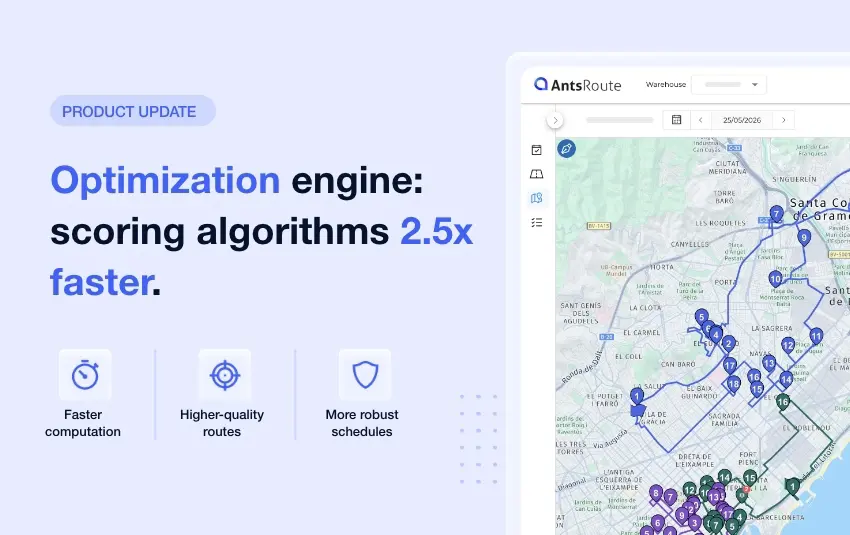
AntsRoute accelerates its optimization engine with scoring algorithms up to 2.5x faster
Blog > Product updates > AntsRoute accelerates its optimization engine with scoring algorithms up to 2.5x faster
AntsRoute accelerates its optimization engine with scoring algorithms up to 2.5x faster
Published on 20 May 2026 • Reading time: 6 min read
Route optimization is not just about calculating a shorter route.
In real-world field operations, every new job can impact the entire schedule: time windows, regulatory constraints, agent skills, route balance, and even the system’s future ability to reorganize efficiently.
To address this complexity, AntsRoute has evolved its scoring and dynamic insertion engine.
Our R&D team completely redesigned the insertion evaluation mechanisms to simultaneously improve:
- calculation speed,
- route quality,
- schedule robustness,
- and the engine’s ability to react efficiently in real-time environments.
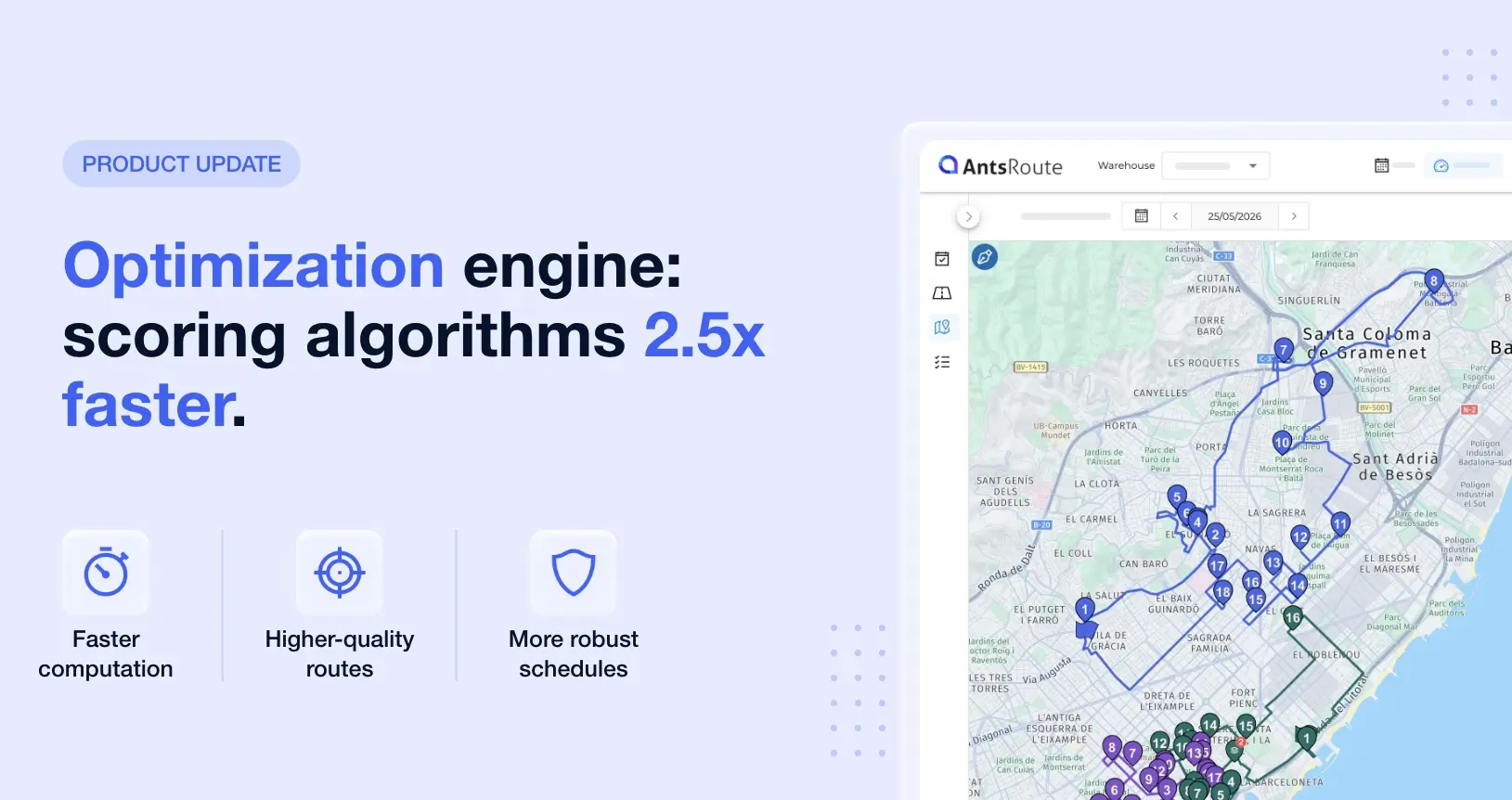
As a result, AntsRoute’s new scoring algorithms are now up to 2.5 times faster.
But behind this performance gain lies a much deeper evolution of the optimization engine’s architecture.
To better understand the challenges of route optimization in last-mile logistics, you can also read our complete article on route optimization.
In this article:
- Why scoring has become central to route optimization
- What’s changing in AntsRoute’s new algorithms
- How the engine evaluates insertion candidates
- Improvements for real-time constraints management
- New local search mechanisms
- The role of warm-start in engine performance
- Why these improvements matter for field operations
Why scoring plays a central role in route optimization
In a dynamic routing engine, the challenge is not just determining whether an insertion is feasible.
The real issue is deciding whether that insertion is a good operational decision.
When a new task needs to be added to an existing schedule, several possibilities may exist:
- different days,
- multiple routes,
- and different positions within each route.
Each insertion candidate has different consequences on the rest of the schedule.
Some significantly increase mileage. Others reduce time margins. Some create unnecessary waiting times, while others make routes much more fragile when facing unexpected events.
As explained by Ammar Oulamara, Head of R&D at AntsRoute:
“A locally optimal insertion can produce a major global degradation of the schedule once all temporal and operational constraints are taken into account.”
The role of scoring is precisely to evaluate these impacts before selecting the best possible insertion.
A new generation of scoring algorithms
The latest evolutions of the AntsRoute engine are based on a major redesign of the insertion evaluation and exploration mechanisms.
The objective was twofold:
- improve computational performance,
- while increasing the quality of the decisions made by the engine.
This new architecture now makes it possible to explore more insertion candidates in a much shorter time.
Concretely, the engine can:
- evaluate available time slots faster,
- reorganize routes more efficiently,
- and react more quickly to field events.
In some complex scenarios, the new algorithms are up to 2.5 times faster than the previous generation.
A much more advanced multi-criteria scoring system
The AntsRoute optimization engine does not simply measure additional distance.
Each insertion is now evaluated through a multi-criteria scoring system that takes into account:
- mileage cost,
- time constraints,
- waiting times,
- geographical consistency,
- driver skills,
- vehicle capacities,
- regulatory constraints,
- as well as the future potential for schedule reorganization.
The engine then transforms all these dimensions into a global score used to rank insertion candidates.
As explained by Ammar Oulamara:
“Two insertions that appear geographically similar can have very different operational impacts. The purpose of scoring is precisely to measure these differences objectively.”
This approach allows the engine to go beyond purely local optimization logic and reason at the scale of the entire schedule.
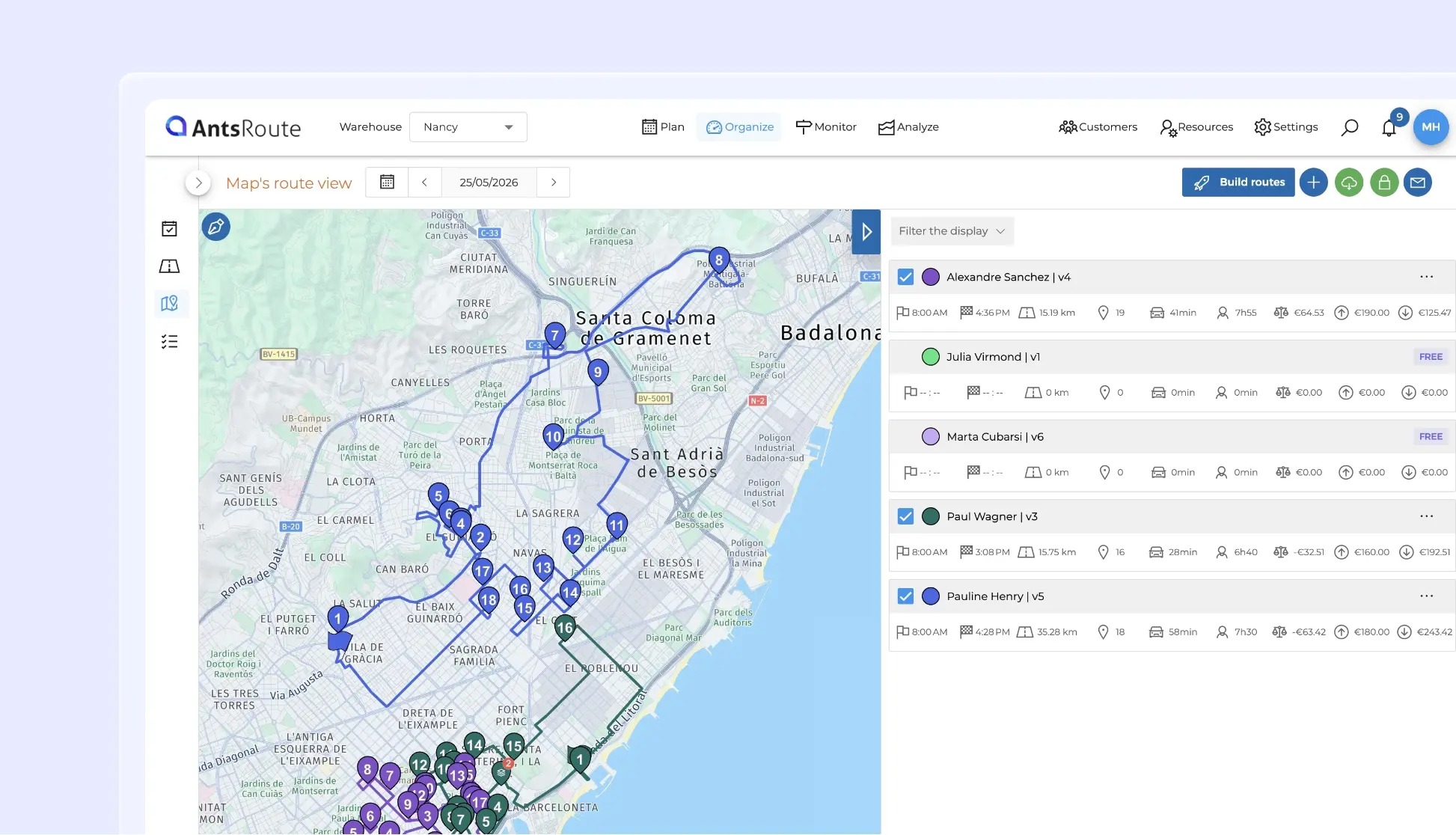
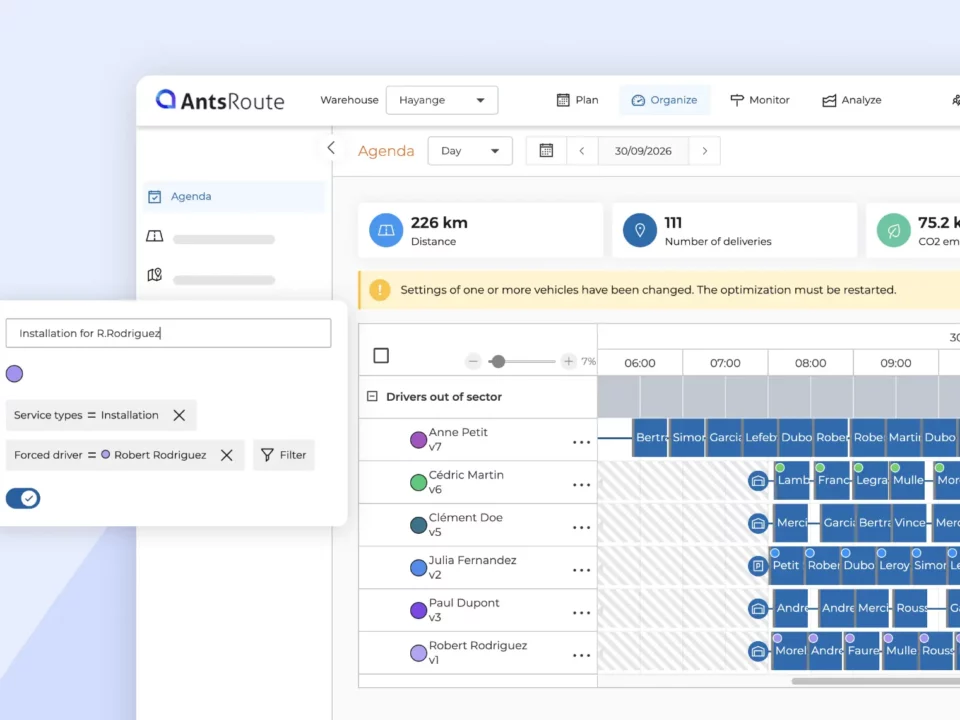
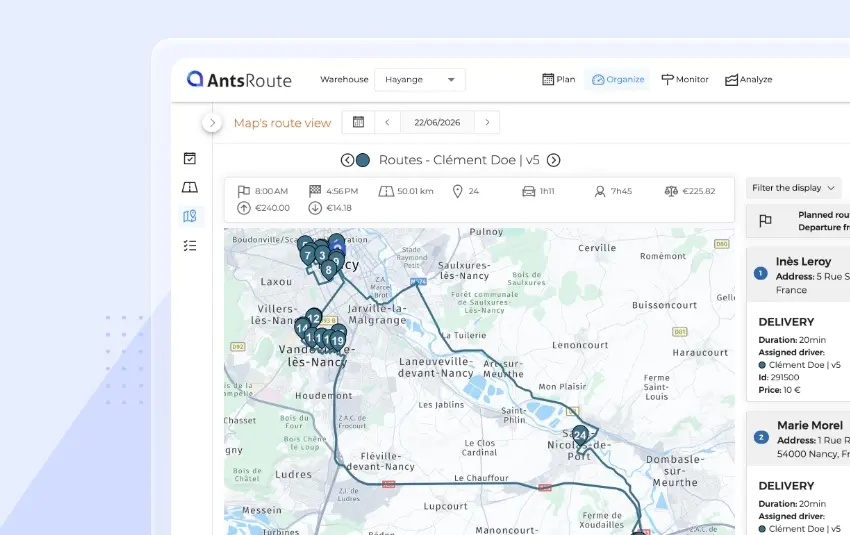
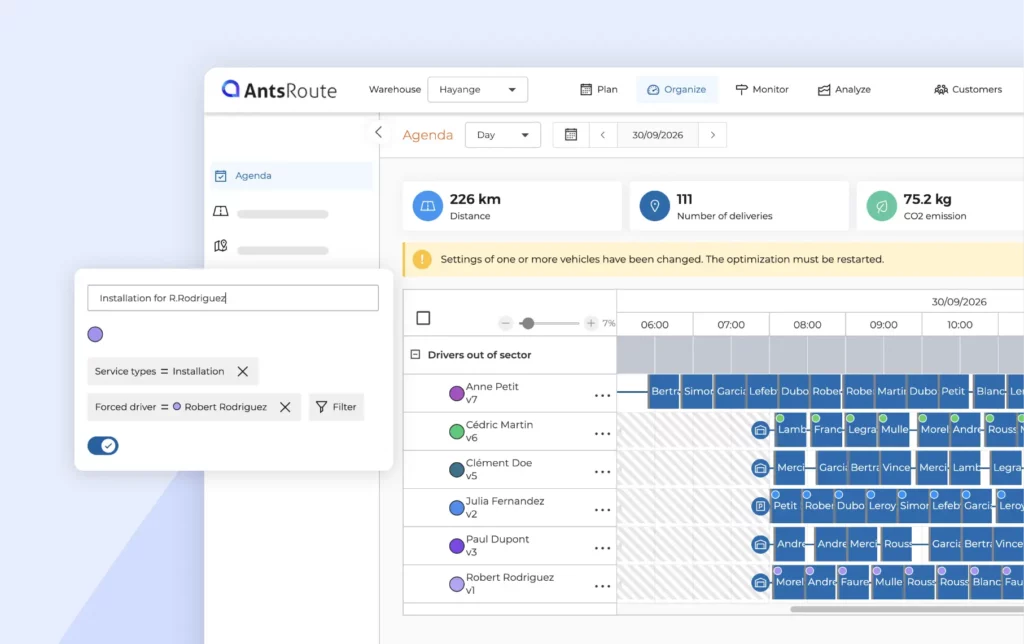
The AntsRoute route optimization software interface.
Better management of real-time constraints
One of the main challenges in route optimization is constraint propagation.
When a new task is added, the engine must dynamically recalculate:
- arrival times,
- waiting times,
- time margins,
- regulatory breaks,
- as well as the feasibility of subsequent jobs.
In VRPTW (Vehicle Routing Problem with Time Windows) scenarios, this propagation becomes particularly complex.
An insertion that appears geographically optimal can become highly inefficient once temporal constraints have been propagated throughout the route.
The AntsRoute engine now includes much faster filtering and evaluation mechanisms in order to focus computational power on the most relevant insertion candidates.
This improvement notably provides:
- better operational responsiveness,
- reduced side effects across the schedule,
- and greater overall route stability.
More efficient local search mechanisms
The engine’s new performance gains also rely on major improvements to its local search mechanisms.
The engine does not simply insert a new task directly into a route.
It also explores multiple local reorganization possibilities in order to improve the overall balance of the schedule.
To achieve this, AntsRoute uses several optimization operators from the field of operations research:
- relocate,
- Or-opt,
- 2-opt,
- 3-opt,
- cross-exchange.
These mechanisms can, for example:
- reduce unnecessary detours,
- restore time margins,
- rebalance certain routes,
- or improve the geographical compactness of operations.
The exploration process now relies on a hierarchy of neighborhoods that dynamically adapts the depth of computation according to the quality of the insertion candidates.
Less promising solutions are eliminated quickly, while the best candidates benefit from much deeper exploration.
As a result, the engine concentrates more computational power on the reorganization strategies that are truly valuable.
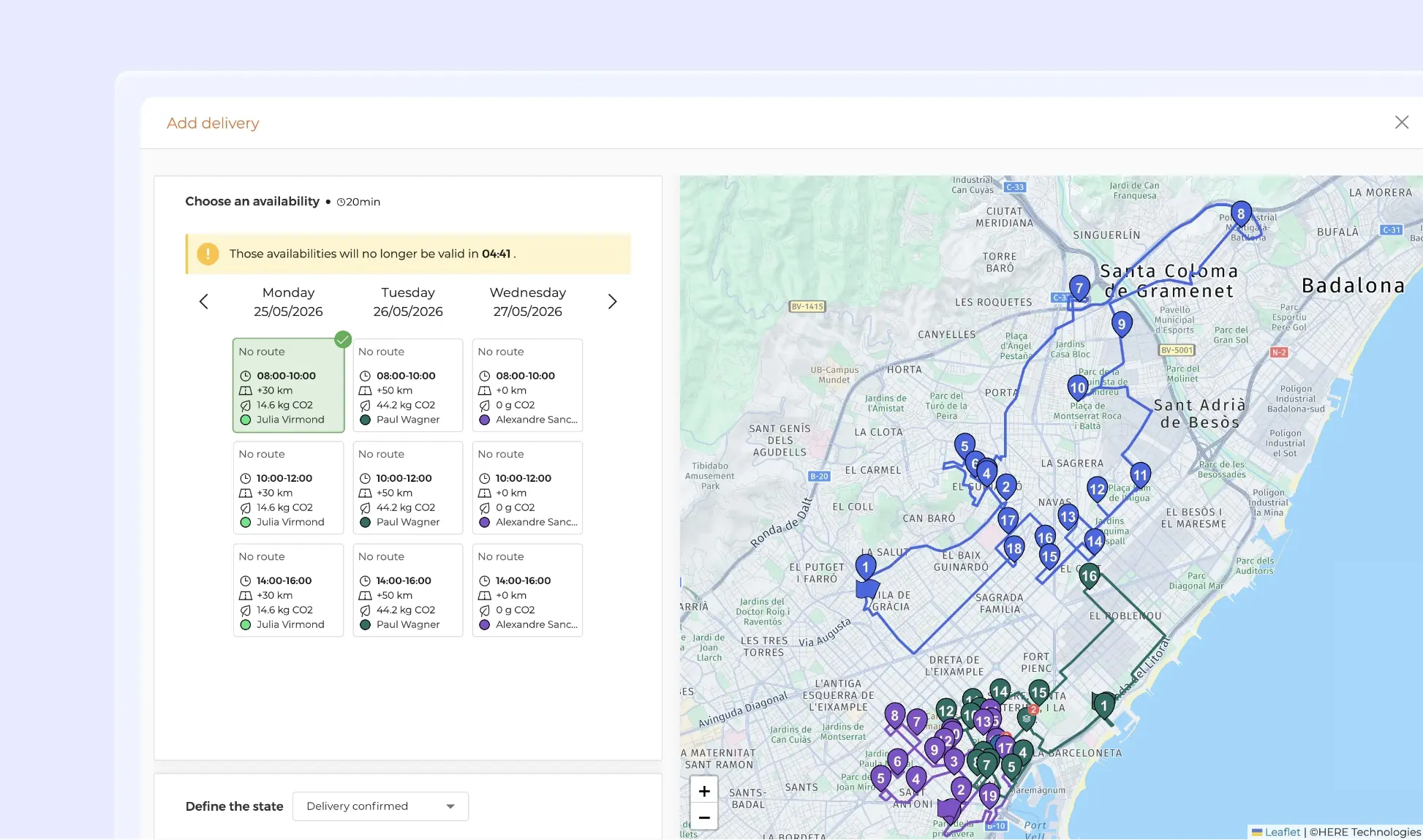
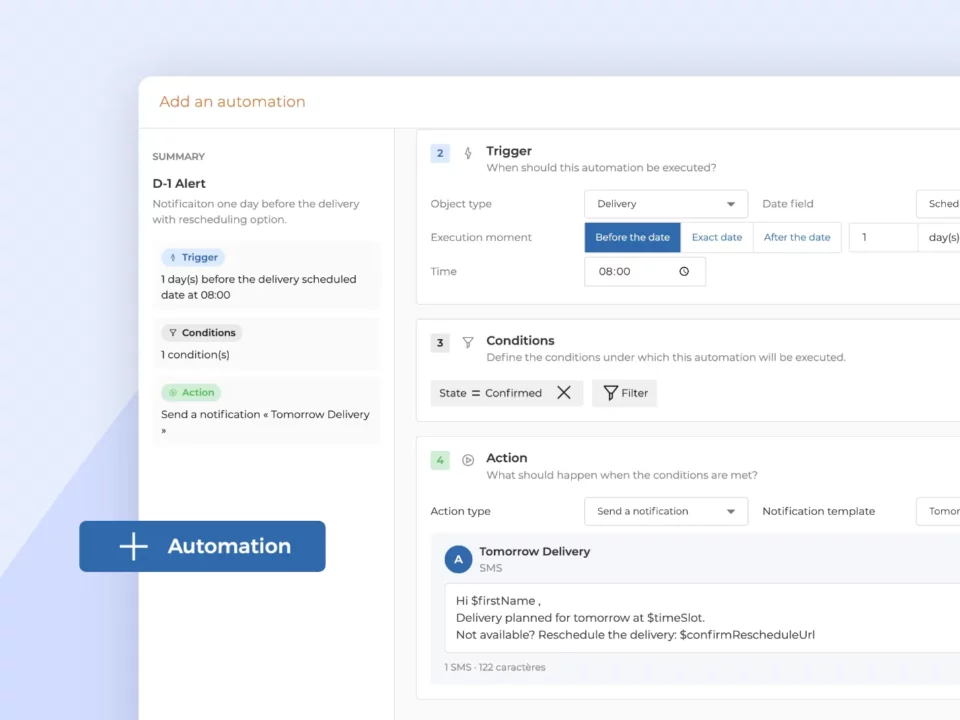
The AntsRoute interface showing the addition of a delivery with availability search.
Warm-start: starting from an already optimized schedule
In real-world operations, a routing engine almost never works on an empty problem.
It must continuously adapt and evolve an existing schedule.
AntsRoute’s new algorithms rely heavily on warm-start mechanisms.
The principle is simple: instead of recalculating routes from scratch, the engine uses the current schedule as the starting point for optimization.
This approach offers several major advantages:
- drastically reduced computation time,
- improved operational stability,
- fewer unnecessary reorganizations,
- and better real-time responsiveness.
As explained by Ammar Oulamara:
“The engine is not looking for the theoretically perfect solution. It is looking for the best operationally usable solution within a computation time compatible with field operations.”
Why these improvements matter for field teams
Route optimization is not just an algorithmic challenge.
These improvements have a direct impact on day-to-day operations.
A faster and smarter engine makes it possible to:
- handle unexpected events more efficiently,
- reduce manual interventions from dispatchers,
- improve route stability,
- limit unnecessary mileage,
- and enhance service quality.
In environments where schedules constantly evolve, reaction speed becomes a key performance factor.
The speed gains delivered by the new algorithms allow the AntsRoute engine to make decisions faster while maintaining an excellent level of optimization quality.
Continuous evolution of the AntsRoute optimization engine
These new performance gains represent an important milestone in the evolution of the AntsRoute optimization engine.
But more importantly, they are part of an ongoing effort to continuously improve our planning architecture.
The objective remains unchanged:
to design engines capable of adapting to real-world operational constraints while delivering decisions that are robust, explainable, and computable in real time.
Because in last-mile logistics, the challenge is not simply to build routes.
The real challenge is continuing to make the right decisions while the schedule is constantly evolving.
Conclusion
With this new generation of scoring algorithms, AntsRoute improves:
- computation speed,
- route quality,
- and the engine’s ability to manage highly constrained dynamic operations.
Thanks to a more advanced multi-criteria scoring architecture, optimized local search mechanisms, and improved real-time constraint management, the engine can now evaluate and reorganize routes up to 2.5 times faster.
This evolution enables field teams to react more quickly while maintaining robust and consistent schedules.
These advancements mark a new milestone in the development of AntsRoute optimization technologies, with additional improvements already planned for the coming months.
If you would like to see how our route optimization solution works in real-world operations, you can also start a free trial of AntsRoute.
WRITTEN BY

Marie Henrion
At AntsRoute, Marie has been the marketing manager since 2018. With a focus on last-mile logistics, she produces content that simplifies complex topics such as route optimization, the ecological transition, and customer satisfaction.
Optimise your Routes Today
Free 7-day trial | No credit card required
Contenu
- Why scoring plays a central role in route optimization
- A new generation of scoring algorithms
- A much more advanced multi-criteria scoring system
- Better management of real-time constraints
- More efficient local search mechanisms
- Warm-start: starting from an already optimized schedule
- Why these improvements matter for field teams
- Continuous evolution of the AntsRoute optimization engine
- Conclusion
- Optimise your Routes Today