Field Service Management: How AI Turns Your Routes into a Growth Opportunity
Blog > Field Service > Field Service Management: How AI Turns Your Routes into a Growth Opportunity
Field Service Management: How AI Turns Your Routes into a Growth Opportunity
Published on 1 April 2026 • Reading time: 8 min read
Field service management is a real juggling act: meeting customer time windows, coordinating technicians, handling last-minute emergencies, and minimising travel time. At a small scale, it remains manageable. But as soon as volumes increase, the Excel + Google Maps combination quickly shows its limits. That’s precisely where artificial intelligence changes the game. Far from the clichés, it automates planning complexity to give teams a smoother, more profitable and, above all, more stress-free way of working.
So, how exactly does AI fit into your routes? What benefits can you expect for your technicians, your planners and your customers? Let us walk you through it.
☝️ Key takeaways
- AI automatically optimizes routes by factoring in all constraints (technicians, time windows, travel times) for fast and reliable planning.
- Real-time management of unexpected events allows schedules to be adjusted instantly without disrupting all operations.
- Measurable business gains: fewer miles traveled, higher productivity, and improved customer satisfaction.
Table of contents:
- Why is field service management reaching breaking point?
- How AI automates planning: the magic of algorithms
- AI and the unexpected: when chaos becomes manageable
- Smoother coordination between the office and the field
- The impact on the customer: from uncertainty to transparency
- Measurable gains: the real ROI of AI
Why is field service management reaching breaking point?
At first glance, planning field jobs seems simple: assigning a technician to an address at a specific time. In reality, it’s a completely different story.
An increasing number of constraints
Planning a job is no longer just about connecting point A to point B. It’s about solving a multi-variable equation:
- Technician availability: holidays, absences, part-time or full-time schedules
- Specific skills: is the available technician qualified to handle this type of boiler or fibre network?
- Time windows: the customer is only available between 2 pm and 4 pm—right when traffic is at its peak
- Geographical areas: some technicians cover a specific zone, others travel further afield
- Actual travel time between each job
- Last-minute emergencies: critical breakdowns, urgent call-outs to be handled within the hour, regulatory requirements
Multiply these variables across 10, 20 or 50 technicians, and you end up with a puzzle that can quickly turn into a logistical nightmare.
Tools that are (too) often unfit for purpose
Many companies still manage their jobs using a patchwork of tools that don’t communicate with each other: Excel for scheduling, Google Maps for routing, WhatsApp for urgent issues, and shared calendars for time off.
The result? Information is scattered, errors start to pile up, and the planner spends more time firefighting than planning ahead.
An invisible… but very real mental load
If you’re the one coordinating your teams’ day-to-day operations, you’ll likely recognise the feeling: keeping track of dozens of variables, managing scheduling conflicts, dealing with the unexpected, and reassuring impatient customers. This constant pressure inevitably leads to suboptimal planning. To stay on the safe side, you build in too much slack into the schedule, avoid taking risks, and ultimately complete fewer jobs than you could.
Your day-to-day reality then looks like this:
- Constantly modifying routes that have already been planned.
- Reassigning jobs at a moment’s notice.
- Handling calls from technicians stuck in traffic.
- Reassuring customers who are waiting, or asking to reschedule their time slot.
A typical example: a small business with 20 technicians can spend several hours a day just organising, then reorganising, routes. Valuable time that isn’t spent on analysis, strategy, or customer relationships.
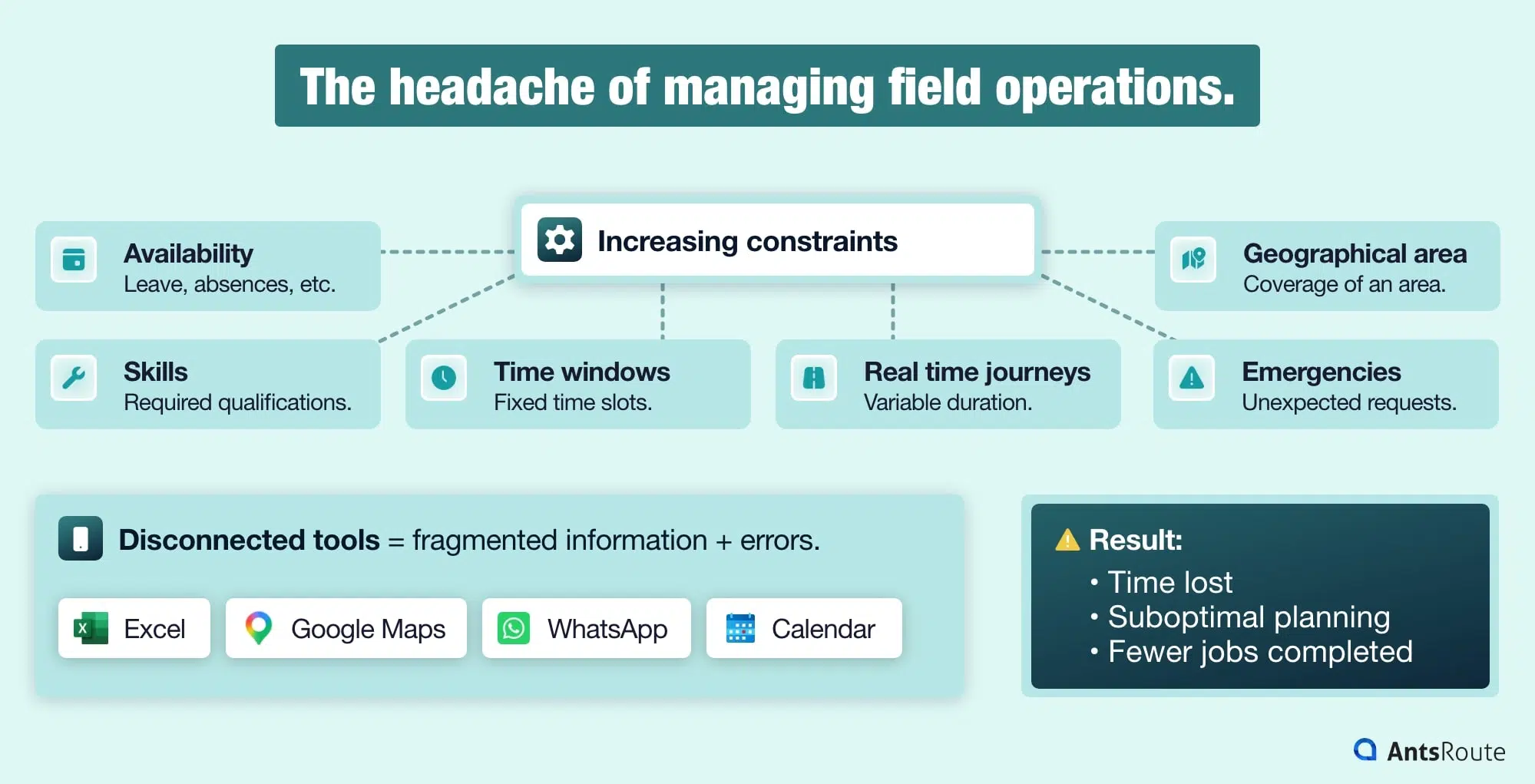
A logistical puzzle with multiple constraints.
How AI automates planning: the magic of algorithms
Artificial intelligence isn’t here to replace humans, but to give them computational superpowers.
Algorithmic optimisation in seconds
Where a human brain might spend an entire morning trying to find the best route for 15 technicians, AntsRoute’s AI analyses millions of combinations in just a few seconds. It simultaneously processes:
- distances between each job and realistic travel times
- customer-imposed time windows
- required and available skill sets
- workload balancing
- regulatory constraints (working hours, mandatory breaks)
Not bad, right?
Automatically generated routes
The planner’s role then shifts: they no longer build everything manually, they oversee the process. In practical terms, they:
- import or enter jobs (addresses, time windows, durations, constraints)
- run the optimisation
- receive a set of consistent routes: stop order, estimated timings, travel times, and more
💡 To gain a detailed understanding of how optimisation works, you can refer to our dedicated guide.
Of course, they remain in control. They can move a job, enforce a specific time slot, or reassign a task. The system then automatically recalculates the impact of that change across all routes.
Smart management of operational constraints
The AI adapts to your on-the-ground reality, not the other way around. It takes into account:
- vehicle capacity (volume, weight,…)
- geographic zones specific to each field agent
- mandatory technical certifications for certain sites
- customer preferences (no visits on Fridays, closed between 12 pm and 2 pm, etc.)
The algorithm takes all these constraints into account with every optimisation, significantly reducing the risk of planning errors. The result: routes that are both realistic and high-performing.
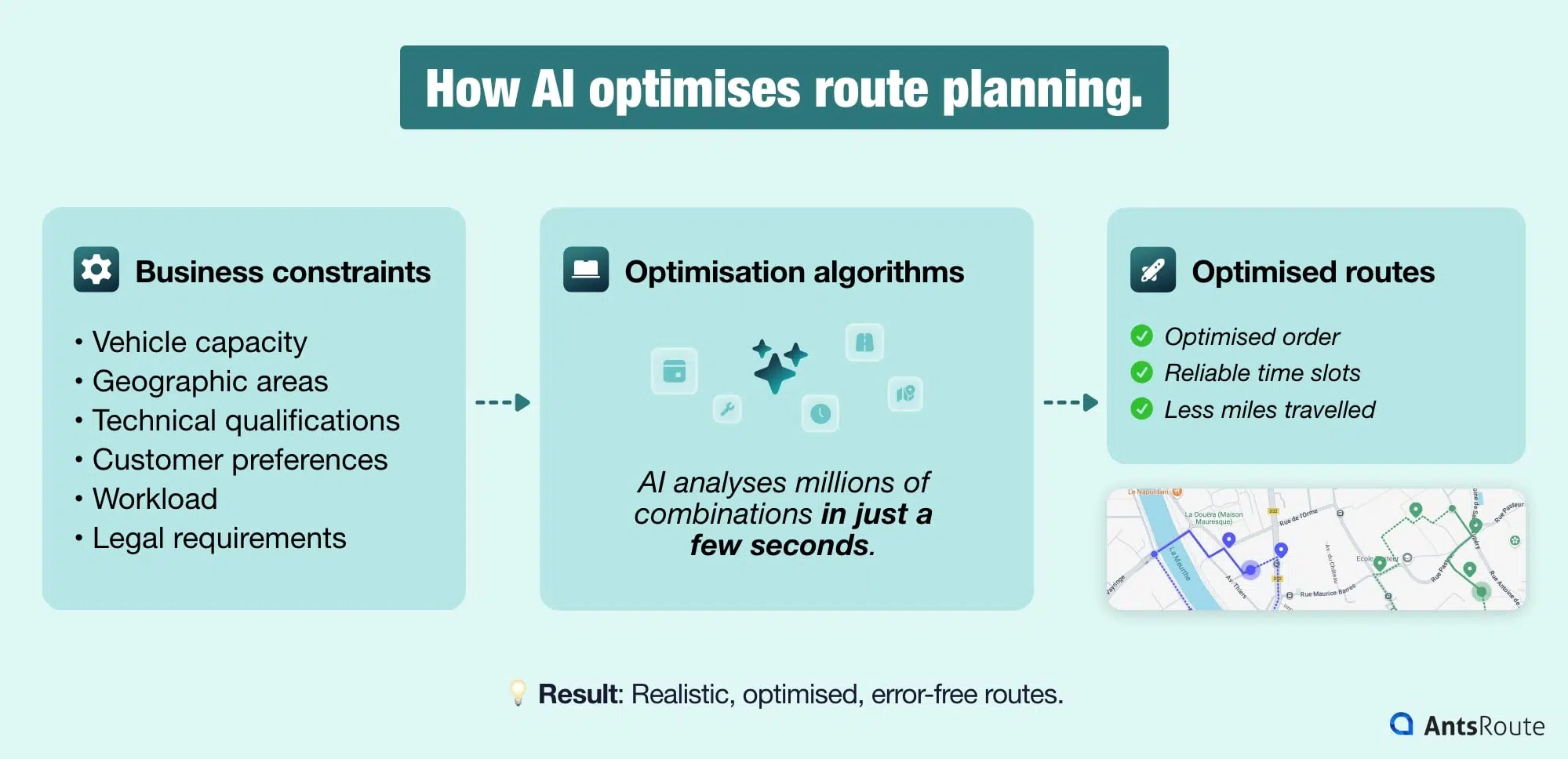
AI analyses thousands of constraints to generate optimised routes in just seconds.
AI and the unexpected: when chaos becomes manageable
The plan set in the morning rarely survives the reality of 2 pm. And that’s exactly where AI proves most valuable, thanks to its ability to dynamically replan.
Responding to urgency without starting from scratch
A customer cancels? A technician breaks down? An urgent job comes in? With AI, the schedule can be automatically recalculated in just a few seconds. The system instantly identifies the most suitable technician: the closest, the most qualified, or the one whose schedule will be least disrupted. No need to start over. What used to take 30 minutes of reshuffling can now be done in just a few clicks, with immediate updates sent to the technician’s mobile app.
The impact on service quality is immediate: less stress, fewer frantic calls, and far fewer delays that customers struggle to understand.
Adapting to traffic conditions
AI can also factor in traffic conditions. If an accident causes major congestion, the system can recalculate the estimated arrival time and, if necessary, swap two appointments to prevent the technician from losing an hour in traffic.
The result: more reliable time slots, greater responsiveness, and field teams under less pressure.
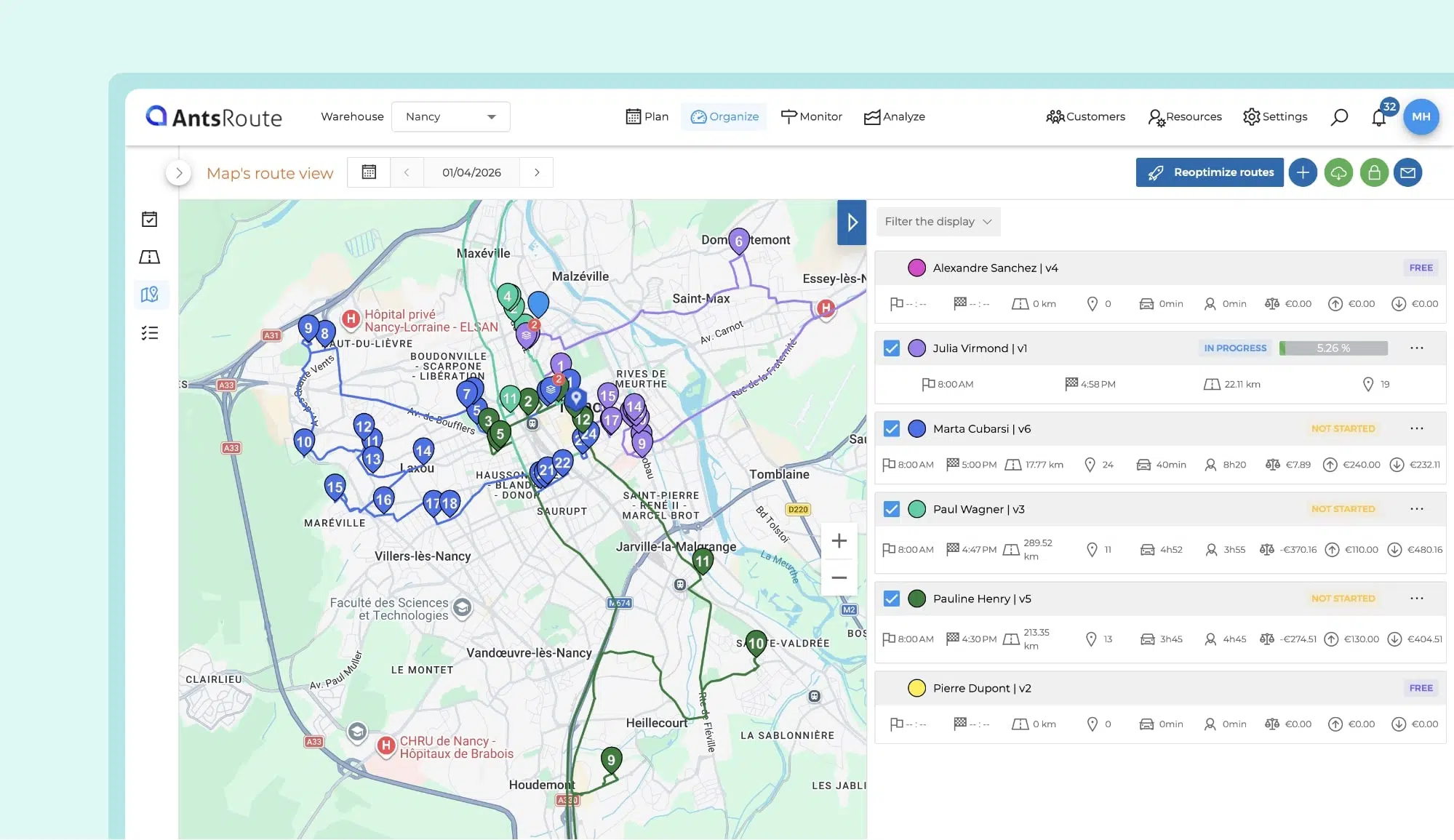
Optimising multiple field service routes with AntsRoute.
Smoother coordination between the office and the field
AI acts as an invisible thread that centralises information and streamlines communication.
Real-time job tracking
With a digital solution, the office has a real-time view of all teams:
- technicians’ locations in the field
- the status of each job: pending, in progress, completed, on hold, rescheduled
- potential delays emerging throughout the day
No more calls asking, “Where are you up to?”. The planner no longer works blind: they can keep customers informed, adjust a route, or slot in a quick job during a gap.
A mobile app for technicians
In the field, technicians use a mobile app that brings together everything they need:
- their schedule for the day (and the days ahead)
- GPS navigation
- job-related information
- specific instructions
- step validation
- photo capture
- customer signature
- digital job reports
The result: fewer oversights, fewer scattered exchanges, and much better traceability.
Centralised communication at last
No more instructions lost between calls, SMS, and WhatsApp. Everything is brought together in a single tool, with a clear history accessible to everyone. It’s simple, but it’s often one of the first benefits businesses notice once the right solution is in place.
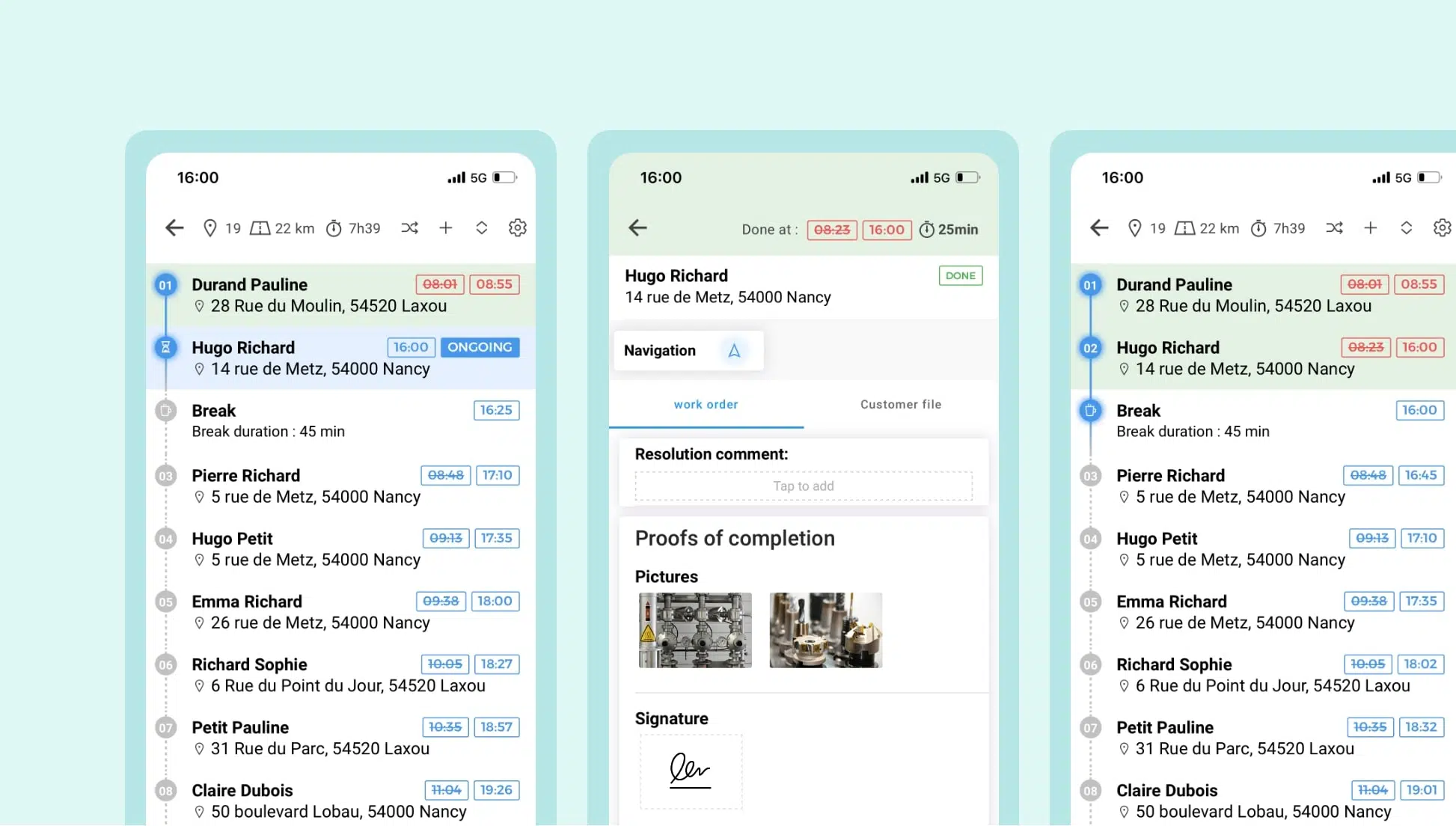
The AntsRoute mobile app for technicians.
The impact on the customer: from uncertainty to transparency
Customers in 2026 no longer want to wait “sometime between 8 am and 6 pm”. And frankly, who can blame them? AI makes it possible to deliver an experience on par with the logistics giants.
More reliable time slot
By better accounting for travel times, constraints and unexpected events, the proposed time slots are far more realistic, based on algorithmic calculations rather than rough guesswork. Time windows are met more consistently, and major delays are anticipated more effectively. Customers gain clearer visibility, and that changes everything.
Automatic notifications
The customer receives an SMS: “Your technician Marc will arrive in 12 minutes”, along with a link to track their approach on a map. As a result, customers no longer need to call to check whether the technician is on the way. They automatically receive:
- a booking confirmation with the scheduled time slot
- a notification when the technician is approaching
- the option to reschedule their appointment if needed
This is the level of service expected today: simple, seamless, and reassuring.
A more transparent experience
The customer knows what’s happening. They know when the technician will arrive, they receive a job report once the visit is completed, and they don’t need to chase for updates. This level of transparency, often underestimated, is one of the strongest drivers of customer loyalty. It reduces misunderstandings such as: “No one showed up” or “I don’t know what was done.”
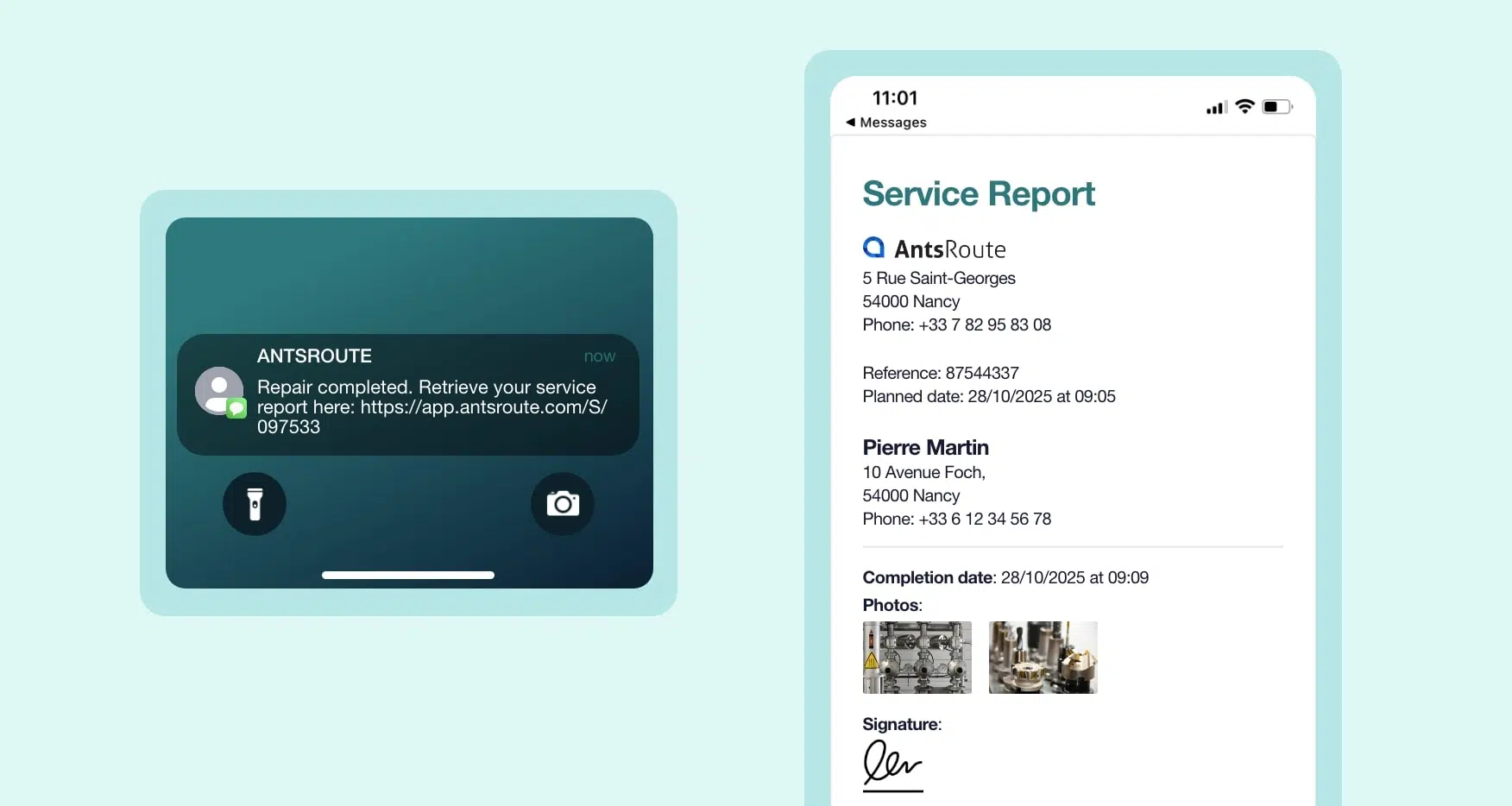
Sending an automated notification with AntsRoute.
Measurable gains: the real ROI of AI
AI doesn’t just bring convenience, it also delivers very tangible results.
Fewer miles, lower costs
By optimising the sequence of jobs, intelligently grouping geographically close customers, and reducing unnecessary detours, businesses can cut:
- the total number of miles travelled
- time spent on the road
- fuel consumption
- vehicle wear and tear
With the added bonus of a smaller carbon footprint.
More jobs per technician, per day
By reducing travel time and simplifying planning, technicians can carry out more jobs within the same day, without extending their working hours. On the office side, the time spent building and rebuilding schedules drops significantly.
Lower operational costs
Fewer miles travelled, less time spent on manual planning, fewer unnecessary return trips, a better-sized fleet… all of this translates into a tangible reduction in operational costs. On top of that come indirect benefits: faster invoicing, fewer disputes, improved customer retention, and reduced staff turnover and pressure on teams.
Data-driven management based on real insights
Modern tools make it possible to continuously track key performance indicators (KPIs), such as:
- first-time fix rate
- punctuality
- average job duration
- miles travelled
- productivity per technician
These insights help identify areas for improvement and enable businesses to manage operations based on facts rather than gut feeling.
| Indicator | Before AI | With AI |
| Scheduling time | 2 to 4 hours per day | 15 to 30 minutes per day |
| Jobs /technician /day | 4 to 6 | 6 to 9 |
| Miles travelled | 100% reference | 15 to 30% reduction |
| Handling unexpected events | Manual, reactive | Automated, proactive |
| Customer satisfaction | Variable | Improved (punctuality, notifications) |
AI is not a threat to planning roles, it’s a liberation. It removes the burden of repetitive calculations so you can reclaim your role as a strategist. No more thankless firefighting; instead, greater visibility and anticipation. In short: less patchwork, more clarity. Less stress, more performance.
For field service businesses, the choice is simple: adopt these tools to gain agility, or stick with manual methods and watch margins erode. Don’t wait: try AntsRoute free for 7 days and see the difference for yourself.
WRITTEN BY

Florine Martin
Florine has been a freelance web copywriter since 2021, writing for a variety of clients in a range of sectors. Since the beginning of 2024, she has been writing articles about logistics for our company, AntsRoute.
Free 7-day trial | No credit card required
Contenu
- Why is field service management reaching breaking point?
- An increasing number of constraints
- Tools that are (too) often unfit for purpose
- An invisible… but very real mental load
- How AI automates planning: the magic of algorithms
- Algorithmic optimisation in seconds
- Automatically generated routes
- Smart management of operational constraints
- AI and the unexpected: when chaos becomes manageable
- Responding to urgency without starting from scratch
- Adapting to traffic conditions
- Smoother coordination between the office and the field
- Real-time job tracking
- A mobile app for technicians
- Centralised communication at last
- The impact on the customer: from uncertainty to transparency
- More reliable time slot
- Automatic notifications
- A more transparent experience
- Measurable gains: the real ROI of AI
- Fewer miles, lower costs
- More jobs per technician, per day
- Lower operational costs
- Data-driven management based on real insights