Why time windows make route optimisation much more difficult
Blog > Route optimisation > Why time windows make route optimisation much more difficult
Why time windows make route optimisation much more difficult
Published on 28 May 2026 • Reading time: 6 min read
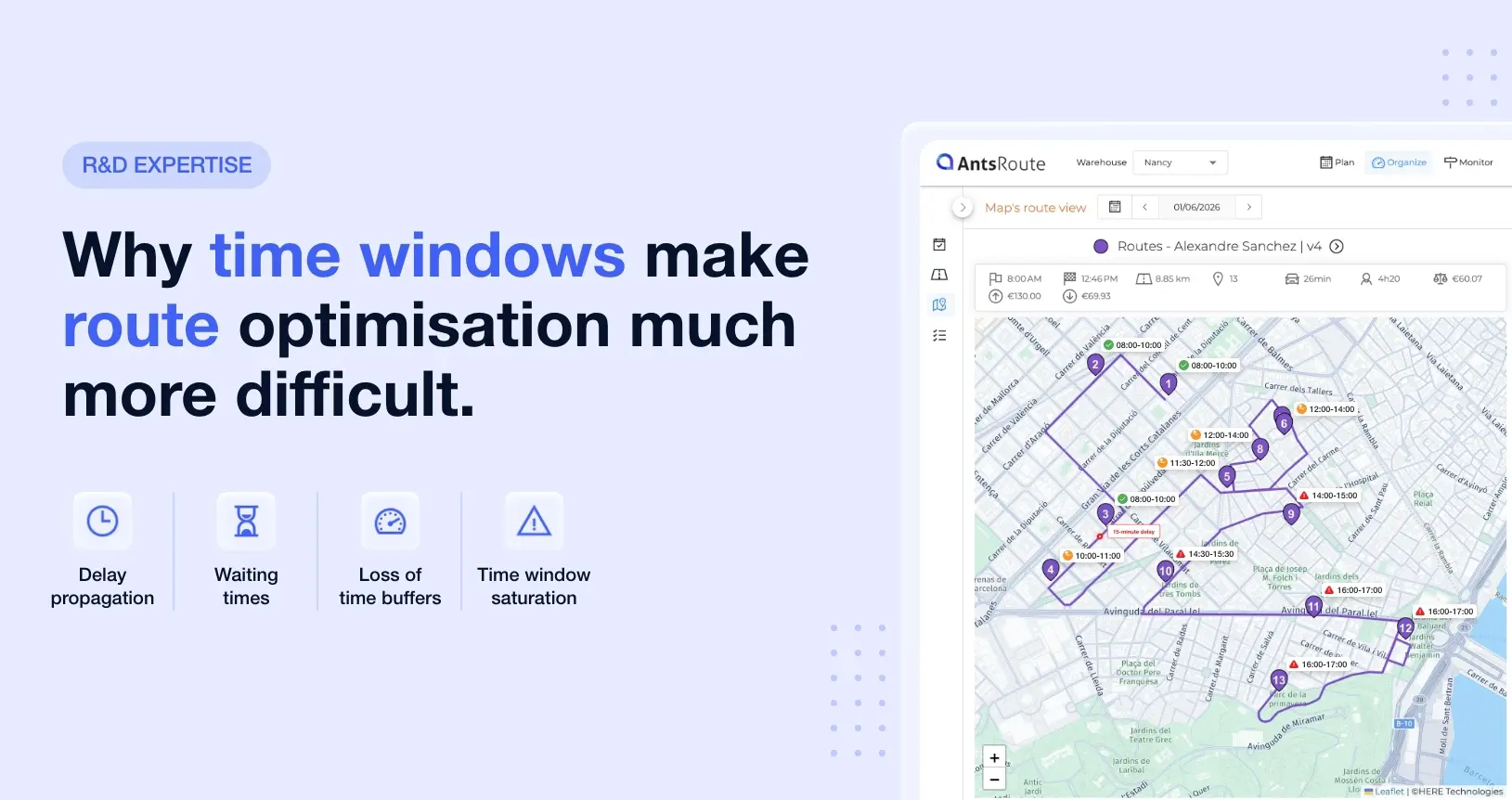
In a classic routing problem, optimising a route essentially means organising a sequence of journeys while minimising the distances travelled.
The introduction of time windows completely changes the nature of the problem.
As soon as each task must be completed within a specific time interval, the route is no longer just a geographical structure. It also becomes a highly constrained temporal structure. And this time-related dimension creates particularly complex effects:
- delay propagation,
- reduced flexibility,
- saturation of certain time slots,
- increased waiting times,
- and the gradual destabilisation of routes.
This is precisely what makes VRPTW (Vehicle Routing Problem with Time Windows) problems far more difficult to solve than traditional routing problems.
This article deliberately focuses on the impact of time constraints within route optimisation engines. For a broader overview of last-mile logistics challenges, you can also read our comprehensive article on route optimisation.
At AntsRoute, this issue plays a central role in the design of the optimisation engine.
What’s covered in this article:
- VRPTW: much more than a distance problem
- Why time propagation makes route planning more complex
- The impact of waiting times on optimisation
- Time windows with very different operational effects
- Why time slot filtering is essential
- Time buffers as a strategic resource
- The side effects of dynamic insertions
- Why exact methods eventually reach their limits
A VRPTW route is no longer just a distance problem
In a traditional VRP, two geographically similar solutions will generally behave in fairly similar ways.
In a VRPTW, that is no longer the case. Two routes that are almost identical spatially can exhibit completely different temporal behaviours depending on:
- customer time windows,
- service durations,
- waiting times,
- or the distribution of time buffers.
As Ammar Oulamara, R&D Manager at AntsRoute, explains:
“As soon as time windows come into play, the problem stops being purely geographical. Every insertion changes a chain of temporal dependencies across the entire route.”
This propagation of constraints is one of the main challenges faced by dynamic routing systems.
Time propagation completely changes the nature of the problem
In a VRPTW, every arrival time implicitly depends on:
- previous travel times,
- service durations,
- accumulated waiting times,
- and the delays generated earlier in the route.
When a new task is inserted, the optimisation engine must dynamically recalculate the entire temporal structure of the schedule: arrival times, waiting times, potential delays, remaining buffers, as well as the feasibility of subsequent jobs.
This propagation creates significant side effects. A delay of just a few minutes in the middle of a route can, for example, shift a mandatory break, eliminate several time buffers, or even trigger violations several stops later.
In highly dense routes, these effects become particularly difficult to absorb.
Waiting times significantly reduce route efficiency
Time windows do not only create delays. They also generate waiting periods when a vehicle arrives before the start of a customer’s time window and must remain idle until the job can begin. In a VRPTW model, this idle time gradually reduces driver productivity, route density, the ability to absorb disruptions, and the overall quality of the schedule.
At AntsRoute, the optimisation engine explicitly penalises these waiting times:
min Σᵢ max(0, eᵢ − tᵢ)
where:
- ei represents the opening time of the customer’s time window;
- and ti the estimated arrival time.
As Ammar Oulamara points out:
“A route can be perfectly feasible while still being operationally poor because of the idle time it creates.”
This distinction is essential.
Not all time windows have the same impact
The complexity of a VRPTW depends heavily on the structure of the time constraints. Wide time windows generally provide greater flexibility, more insertion possibilities, and a better ability to reorganise the schedule.
Conversely, very narrow time windows drastically reduce the search space. In some cases, just a few critical jobs are enough to completely lock certain parts of the schedule. The optimisation engine must then deal with:
- high temporal density,
- extremely limited buffers,
- and much faster propagation of constraint violations.
This temporal saturation is one of the main sources of complexity in last-mile routing operations.
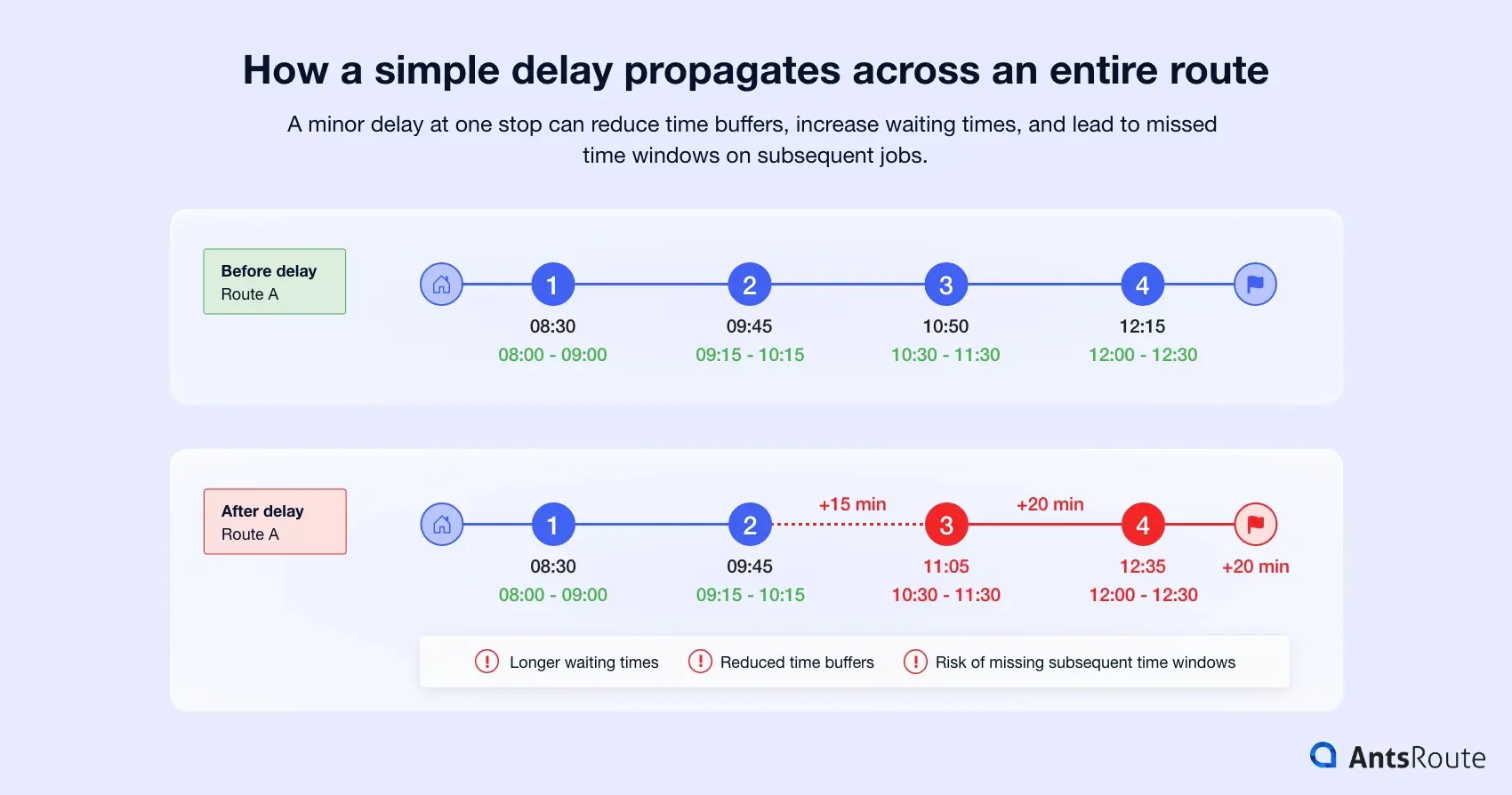
In a VRPTW problem, even a minor delay can propagate throughout the entire route, reduce the available time buffers, and compromise compliance with subsequent time windows.
Filtering candidate time slots becomes essential
Faced with such a highly constrained search space, exploring every possible insertion would be far too computationally expensive. Before even calculating optimisation scores, the engine therefore filters candidate time slots. The objective is to immediately eliminate:
- positions incompatible with customer time windows,
- clearly infeasible insertions,
- or solutions likely to generate significant violations.
As Ammar Oulamara explains:
“Filtering candidate time slots allows computational power to be focused on insertions that are genuinely viable.”
This step is essential to maintain:
- response times compatible with real-time operations,
- while still preserving a high level of optimisation quality.
Time buffers become a strategic resource
In dynamic routing operations, time buffers play a fundamental role. They represent the schedule’s ability to absorb:
- traffic disruptions,
- delays,
- service overruns,
- or last-minute emergencies.
An insertion may therefore remain technically feasible while still destroying a large portion of these buffers. The optimisation engine must not only verify the immediate validity of a route, but also its future temporal robustness.
As Ammar Oulamara points out:
“The challenge is not simply to build a valid route. It is to build a route capable of surviving real-world disruptions.”
This explains why some insertions that appear geographically inexpensive are nevertheless heavily penalised.
Time windows amplify the side effects of insertions
In a dynamic routing system, an insertion rarely affects only the route concerned. When certain time slots become saturated:
- inter-route exchanges may become necessary,
- some critical resources can become locked,
- and much broader reorganisations may be triggered.
The optimisation engine must therefore reason at the scale of the entire schedule, rather than solely at the local route level.
This is precisely why modern optimisation engines combine multi-criteria scoring, local search, multiple neighbourhood strategies, and progressive re-optimisation mechanisms.
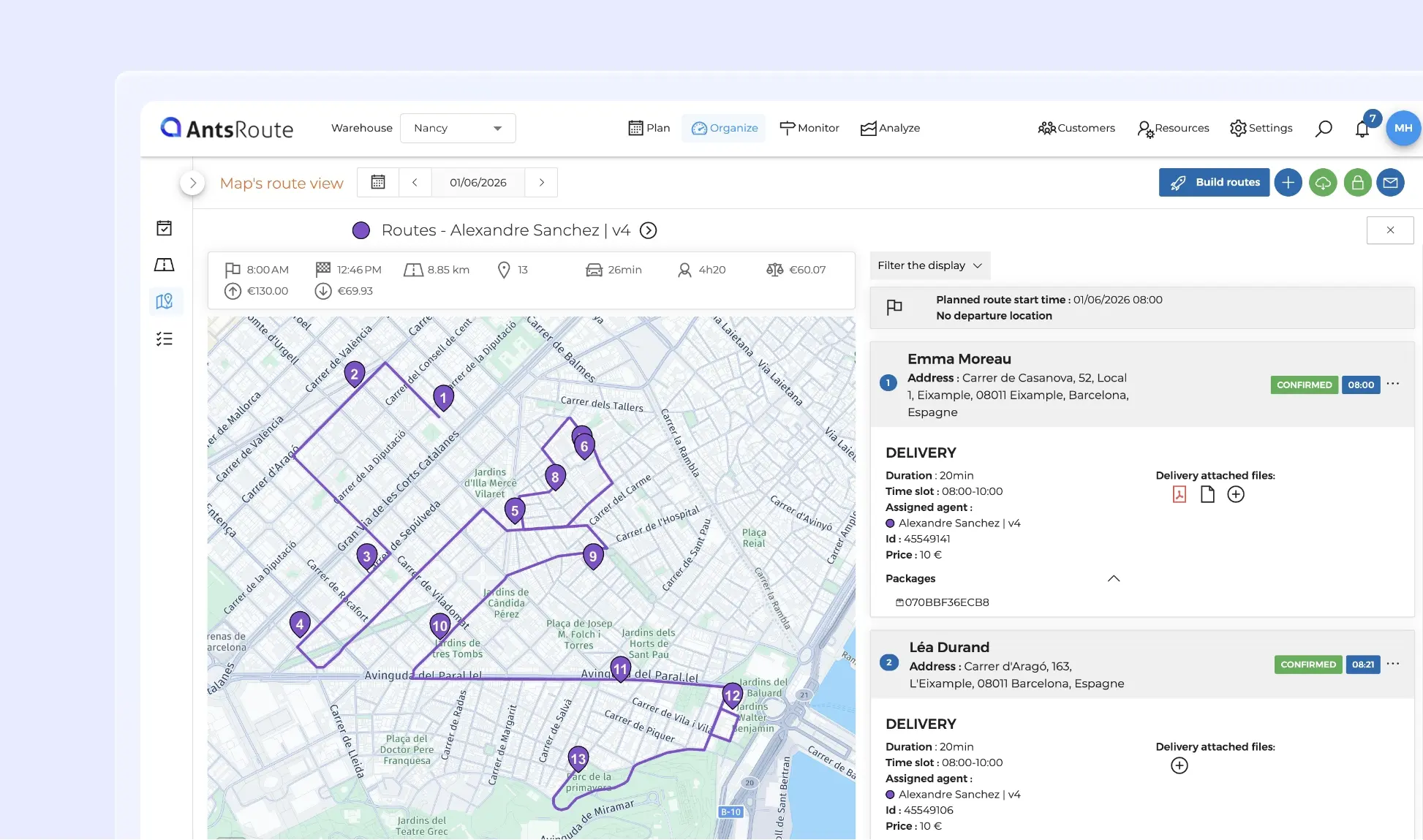
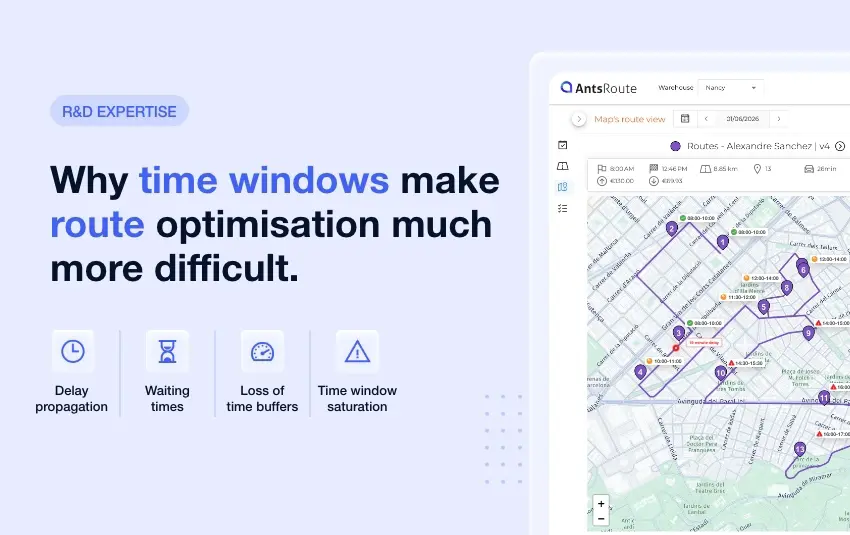
Example of an optimised route in AntsRoute with delivery time windows that must be respected.
Why exact methods quickly reach their limits
From a theoretical perspective, VRPTW problems belong to a particularly difficult class of combinatorial optimisation problems. As:
- the number of tasks increases,
- time windows become tighter,
- and operational constraints multiply, the search space grows exponentially.
Exact methods therefore quickly become incompatible with the operational requirements of real-time environments.
As Ammar Oulamara explains:
“In dynamic environments, the challenge is not simply to produce a good solution. Above all, it is about producing a robust solution quickly.”
This is why modern optimisation engines rely heavily on:
- heuristics,
- warm-start mechanisms,
- local search techniques,
- and adaptive exploration strategies.
Conclusion
Time windows fundamentally transform route optimisation problems because they introduce strong temporal dependencies, propagation effects, waiting times, local saturation, and robustness constraints that are far more difficult to manage.
In a VRPTW, a route must therefore do more than simply minimise geographical distance. It must also preserve time buffers, maintain the ability to absorb disruptions, and remain stable enough to operate effectively in a dynamic environment.
It is precisely this temporal dimension that now makes VRPTW one of the most complex challenges in last-mile logistics.
WRITTEN BY

Marie Henrion
At AntsRoute, Marie has been the marketing manager since 2018. With a focus on last-mile logistics, she produces content that simplifies complex topics such as route optimization, the ecological transition, and customer satisfaction.
Free 7-day trial | No credit card required
Contenu
- A VRPTW route is no longer just a distance problem
- Time propagation completely changes the nature of the problem
- Waiting times significantly reduce route efficiency
- Not all time windows have the same impact
- Filtering candidate time slots becomes essential
- Time buffers become a strategic resource
- Time windows amplify the side effects of insertions
- Why exact methods quickly reach their limits
- Conclusion