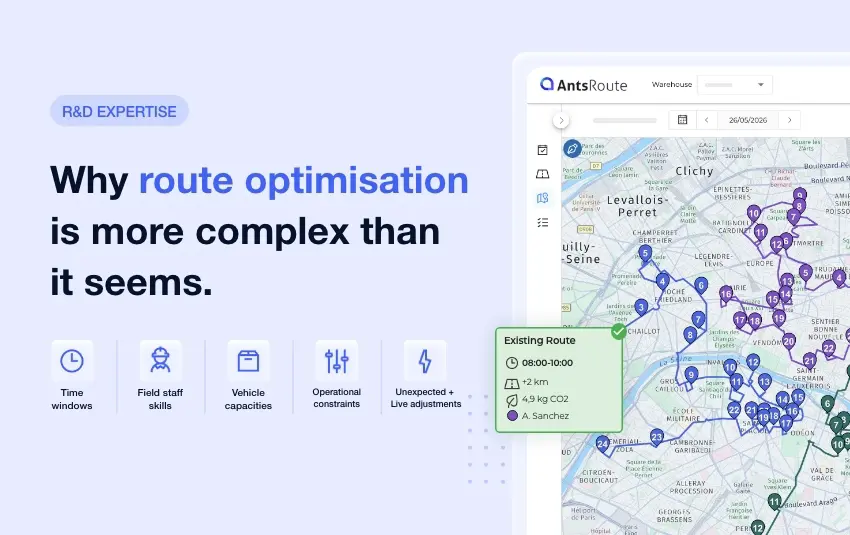
Why route optimisation is a much more complex problem than it seems
Blog > Route optimisation > Why route optimisation is a much more complex problem than it seems
Why route optimisation is a much more complex problem than it seems
Published on 21 May 2026 • Reading time: 8 min read
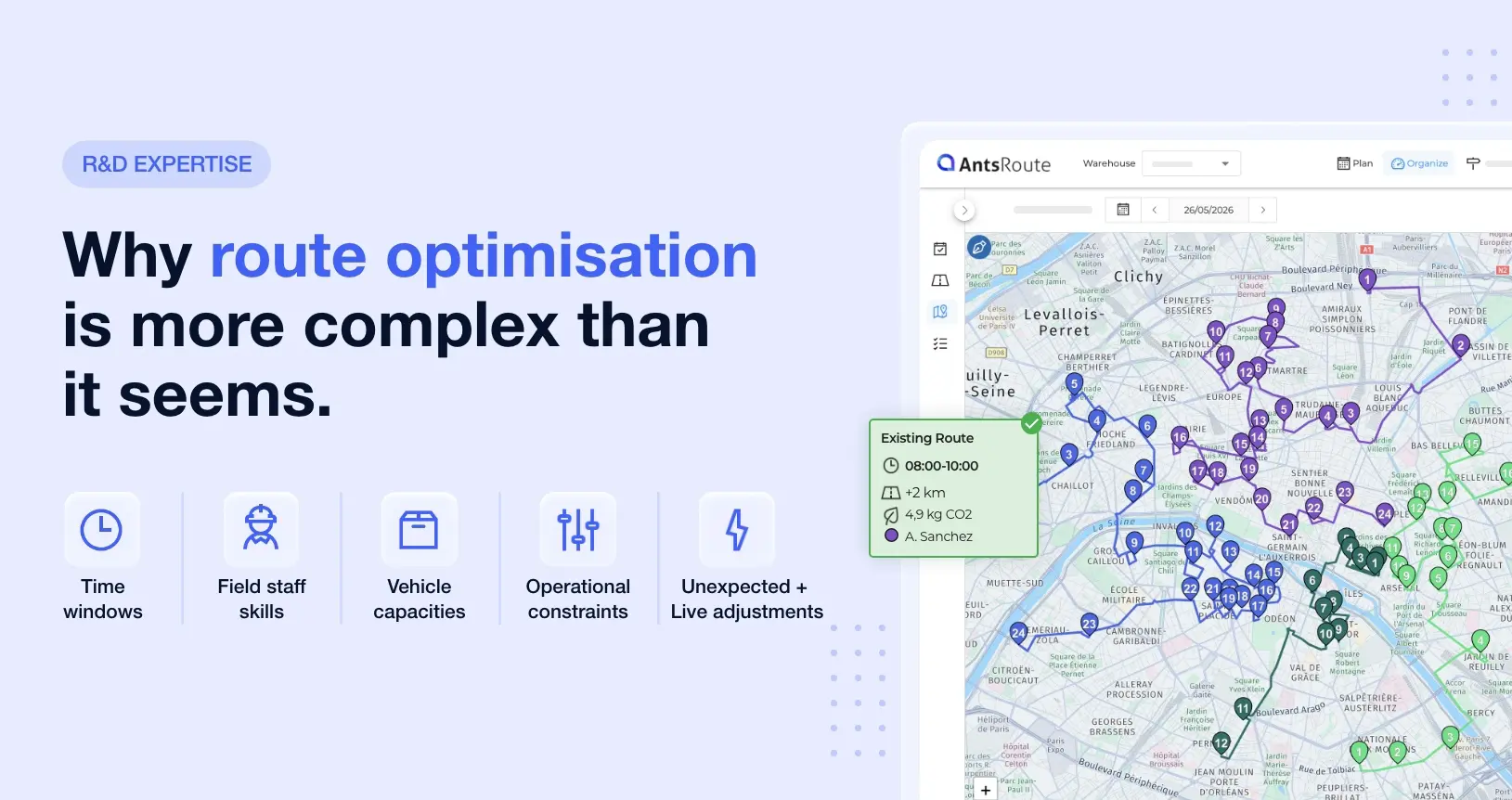
For a long time, route optimisation was seen as a relatively simple problem: calculating the best possible route between multiple locations.
In operational reality, things are obviously far more complex.
A route is never just a sequence of addresses. It has to deal with time constraints, field staff skills, vehicle capacities, varying service durations, urgent requests, last-minute customer demands, and constant reassignment throughout the day.
And above all, a route is almost never fixed.
In last-mile logistics, the real challenge is not simply building an efficient schedule in the morning. The real difficulty lies in adapting it intelligently throughout the day without disrupting the overall balance of operations.
It is precisely this challenge that led our R&D team at AntsRoute to develop advanced dynamic insertion and route scoring mechanisms.
In this article:
- Why a route actually hides a much more complex mathematical problem than it seems
- The real challenge: adapting a schedule in real time
- Why traditional tools quickly reach their limits
- How our engine evaluates every potential insertion
- Why distance alone is never enough
- The impact of time windows on route optimisation
- Operational constraints at the heart of the optimisation engine’s decisions
- Why heuristics have become essential
- Behind the algorithms: very real challenges for field operations
Behind a “simple” route lies an extremely complex mathematical problem
From the outside, adding a new delivery or service appointment into an existing route may seem fairly straightforward. In theory, you simply need to find a “gap” in the schedule.
In practice, however, the consequences are often far more significant.
A single insertion can affect:
- subsequent arrival times,
- waiting times,
- mandatory breaks,
- vehicle load capacity,
- the feasibility of other service appointments,
- and even the overall balance between field teams.
As Ammar Oulamara, Head of R&D at AntsRoute explains:
“Adding a single task into an existing route can alter the entire set of time and operational constraints within the schedule. An insertion that seems geographically logical can become a very poor choice once all operational constraints are taken into account.”
This challenge is well known in the field of operations research under the name Vehicle Routing Problem (VRP).
The theoretical principle seems relatively straightforward: finding the best possible routes for a fleet of vehicles.
But as soon as real-world constraints are introduced — time windows, field staff skills, vehicle capacities, Pick-up & Delivery, or real-time reoptimisation — the problem quickly becomes enormously complex from a combinatorial perspective.
This is particularly true for the Vehicle Routing Problem with Time Windows (VRPTW), where every service appointment must be completed within a specific time window.
With just a few dozen stops, the number of possible combinations already becomes massive. And in real-world field operations, schedules are constantly evolving.
In other words, it becomes impossible to exhaustively explore every possible option.
The real challenge is not building a route… but adapting it intelligently
In many theoretical approaches, routes are built “once and for all”.
But real-world operations never work that way.
Operations teams have to deal with:
- urgent requests,
- cancellations,
- delays,
- traffic,
- staff absences,
- customer changes,
- and unexpected field constraints.
This is exactly why many teams describe their day-to-day work as a constant “balancing act” when managing schedules.
The problem then becomes far more difficult: how can you intelligently insert a new task into an already optimised schedule without disrupting the overall balance of the routes?
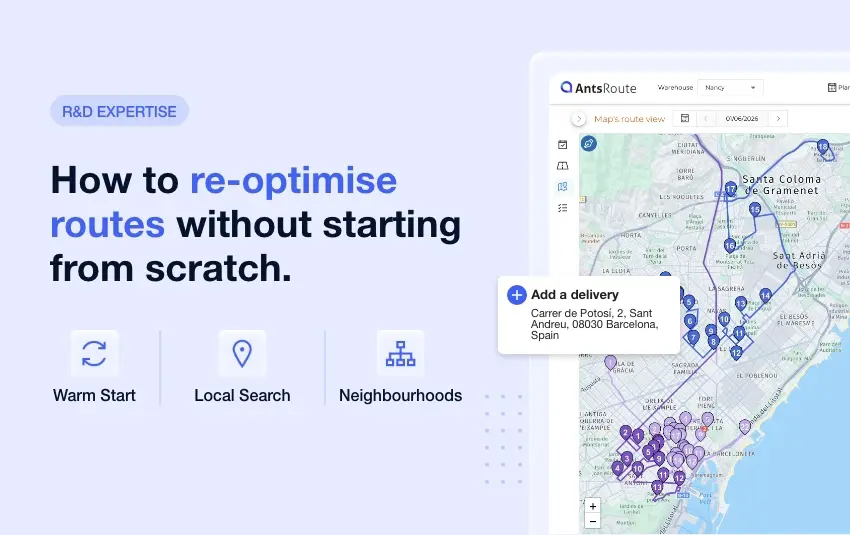
We explore this issue in greater detail in our article dedicated to dynamic task insertion and propagation effects within routes.
This challenge is precisely where a large part of our R&D team’s work is focused.
“The real challenge is not simply building an optimal route in the morning,” explains Ammar Oulamara. “The real difficulty is adapting that schedule throughout the day without creating uncontrolled knock-on effects.”
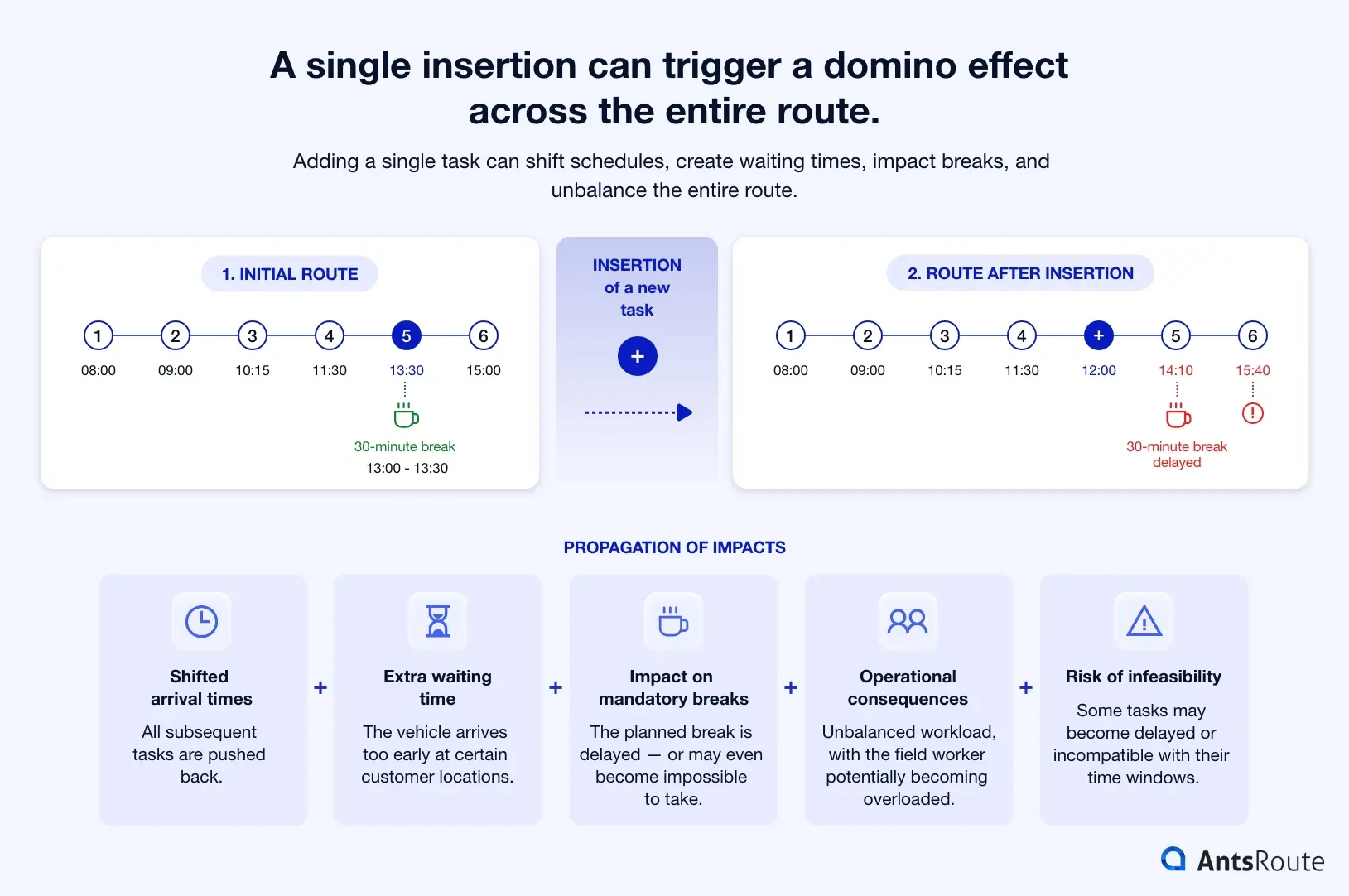
Example of constraint propagation within a dynamic route: a single insertion can alter schedules, mandatory breaks, and the overall robustness of the planning.
Why traditional tools quickly reach their limits
Many organisations naturally start with simple tools: Excel, Google Maps, phone calls, SMS, or several partially connected software solutions.
At a small scale, this can work reasonably well.
But as soon as:
- activity volumes increase,
- operational constraints multiply,
- teams grow,
- or customers require more precise time slots,
managing operations manually becomes extremely difficult to sustain.
The issue is not simply the volume of data.
The real challenge lies in the number of interdependencies between decisions.
Changing a single route can have consequences across the entire schedule.
This is precisely why purely manual or partially manual approaches quickly reach their limits.
How our optimisation engine evaluates every possible insertion
At AntsRoute, we developed an approach based on a multi-criteria scoring algorithm.
The goal is not simply to find an available slot.
Instead, the engine evaluates the overall quality of every potential insertion.
In practical terms, when a new task needs to be added, several possibilities may exist:
- different days,
- multiple routes,
- and different positions within each route.
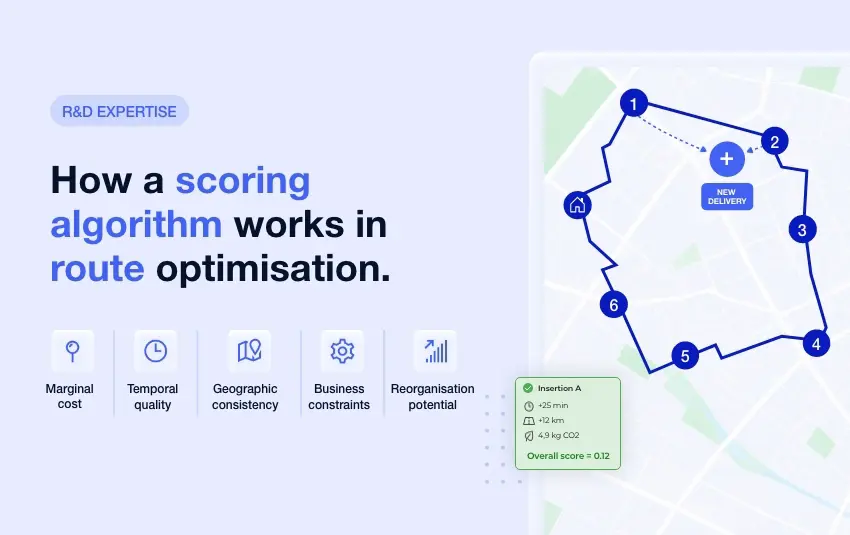
Each potential combination is then assessed through an insertion score.
We also explain how this mechanism works in more detail in our dedicated article on scoring algorithms in route optimisation.
As Ammar Oulamara explains:
“Two insertions that appear geographically close can have very different operational impacts. The purpose of scoring is precisely to evaluate those differences objectively.”
The engine therefore does not look solely at the additional distance generated.
It also takes into account:
- time constraints,
- waiting times,
- geographical consistency,
- required skills,
- vehicle capacities,
- working time limits,
- and the potential for localised reorganisation.
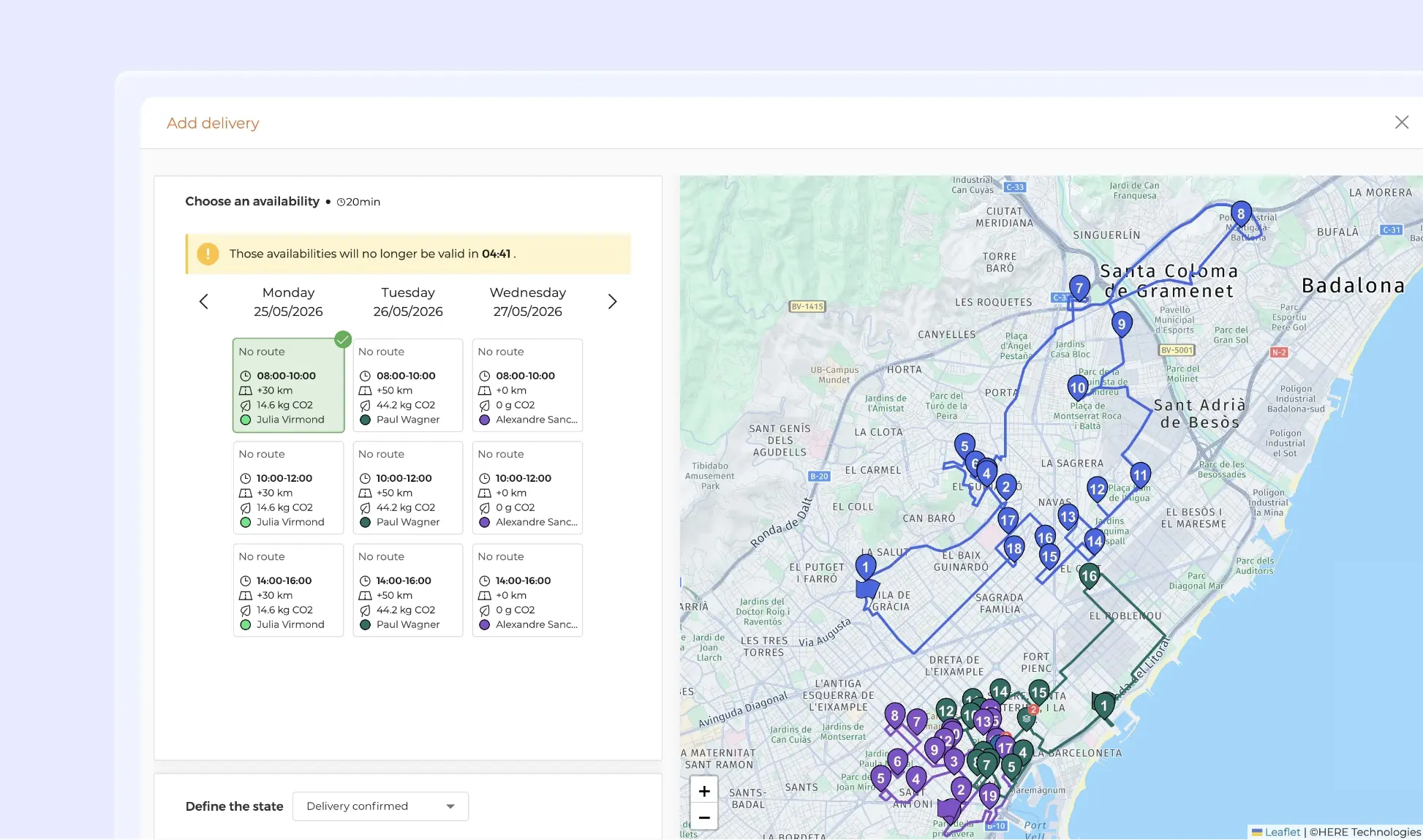
Adding a delivery with multiple availability time slots in AntsRoute.
Why distance alone is never enough
One of the first indicators used is measuring the marginal cost generated by adding a new task into an existing route.
Δc = c(vₚ₋₁, τ) + c(τ, vₚ) − c(vₚ₋₁, vₚ)
This formula makes it possible to assess the actual additional cost introduced by the insertion.
But in real-world operations, distance alone is never enough to make a good decision.
For example, an insertion that appears geographically “close” may:
- trigger cascading delays,
- create waiting time,
- unbalance an entire route,
- or make a subsequent service appointment impossible.
This is precisely why time windows play a central role in modern optimisation algorithms.
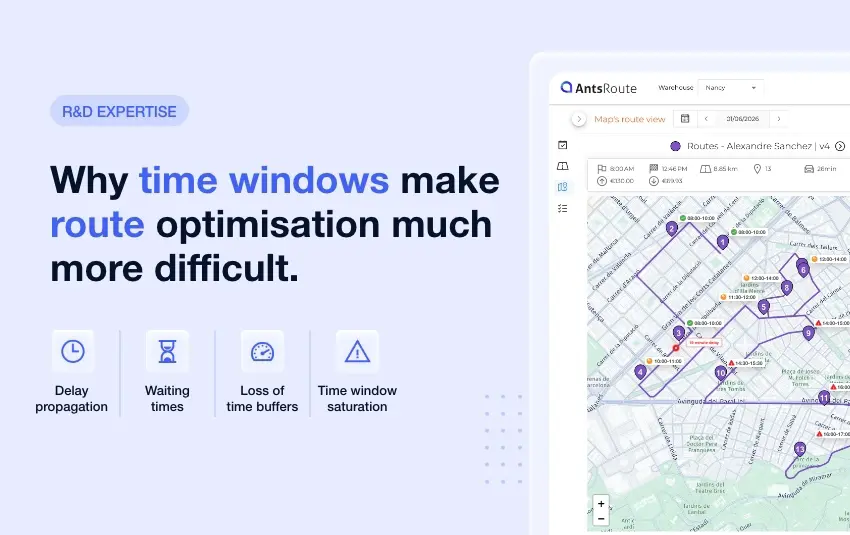
To explore this issue further, we also explain why time constraints make Vehicle Routing Problem with Time Windows (VRPTW) far more complex to optimise.
Time windows fundamentally change the problem
In most field operations, tasks cannot simply be completed at any time.
Some customers require:
- a delivery between 10 a.m. and 11 a.m.,
- a service appointment before midday,
- or a visit after a specific time.
These constraints fundamentally transform route optimisation.
A vehicle may sometimes arrive too early and be forced to wait before the service can begin.
Our engine therefore also integrates waiting times into its route evaluation.
min Σᵢ max(0, eᵢ − tᵢ)
The objective is to reduce unproductive periods as much as possible, as they negatively impact the operational quality of routes.
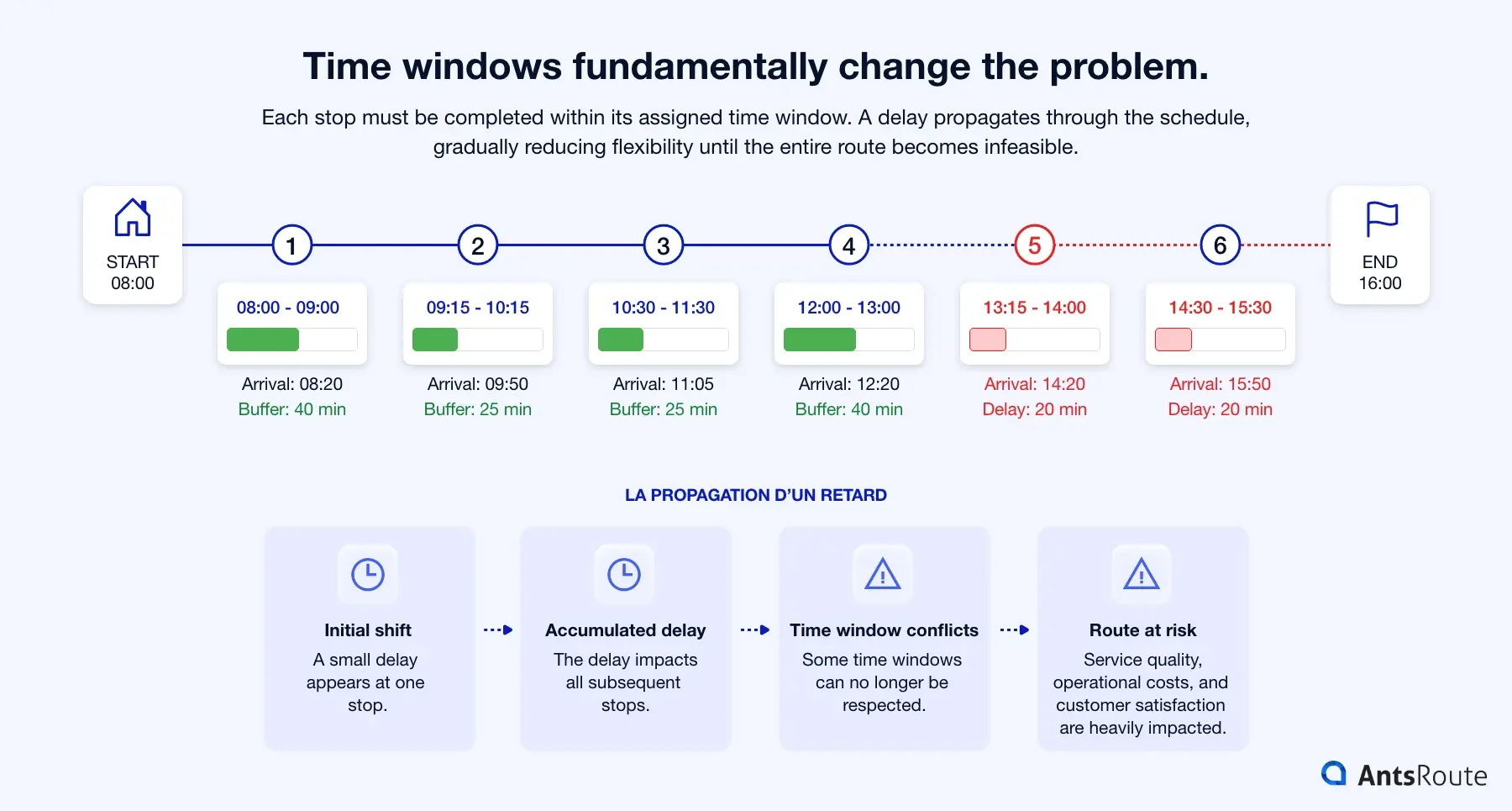
In vehicle routing problems with time windows (VRPTW), even a small delay can cascade through the entire schedule, reduce the available buffers and make certain jobs incompatible with their assigned time windows.
Operational constraints are often the real core of the problem
In many logistics projects, the challenge is not purely geographical.
It is operational.
As Ammar Oulamara points out:
“The optimisation engine must reason using real-world operational constraints, not just distances on a map.”
Some service appointments require:
- specific skills,
- certifications,
- specialised equipment,
- or dedicated staff assignments.
Others involve:
- pickup & delivery constraints,
- maximum working time limits,
- mandatory breaks,
- or organisation-specific rules.
This operational reality is often what separates theoretical models from systems that are genuinely usable in the field.
Why heuristics have become essential
Faced with this level of complexity, exhaustive approaches quickly become unrealistic.
Exploring every possible combination would require computation times that are incompatible with the operational demands of last-mile logistics.
This is why modern optimisation engines rely heavily on heuristics and local search mechanisms.
The goal is not necessarily to find the mathematically perfect solution.
The real objective is to quickly produce a solution that is:
- robust,
- consistent,
- and operationally viable.
At AntsRoute, our approach notably relies on:
- warm-start mechanisms,
- local search operators,
- and adaptive exploration strategies.
We explore these reoptimisation mechanisms in greater detail in our article dedicated to warm-start techniques, local search, and neighbourhood strategies used in dynamic route optimisation engines.
“Exploring every possibility would be far too expensive in terms of computation time,” explains Ammar Oulamara. “The real challenge is intelligently focusing computing power on the most promising insertions.”
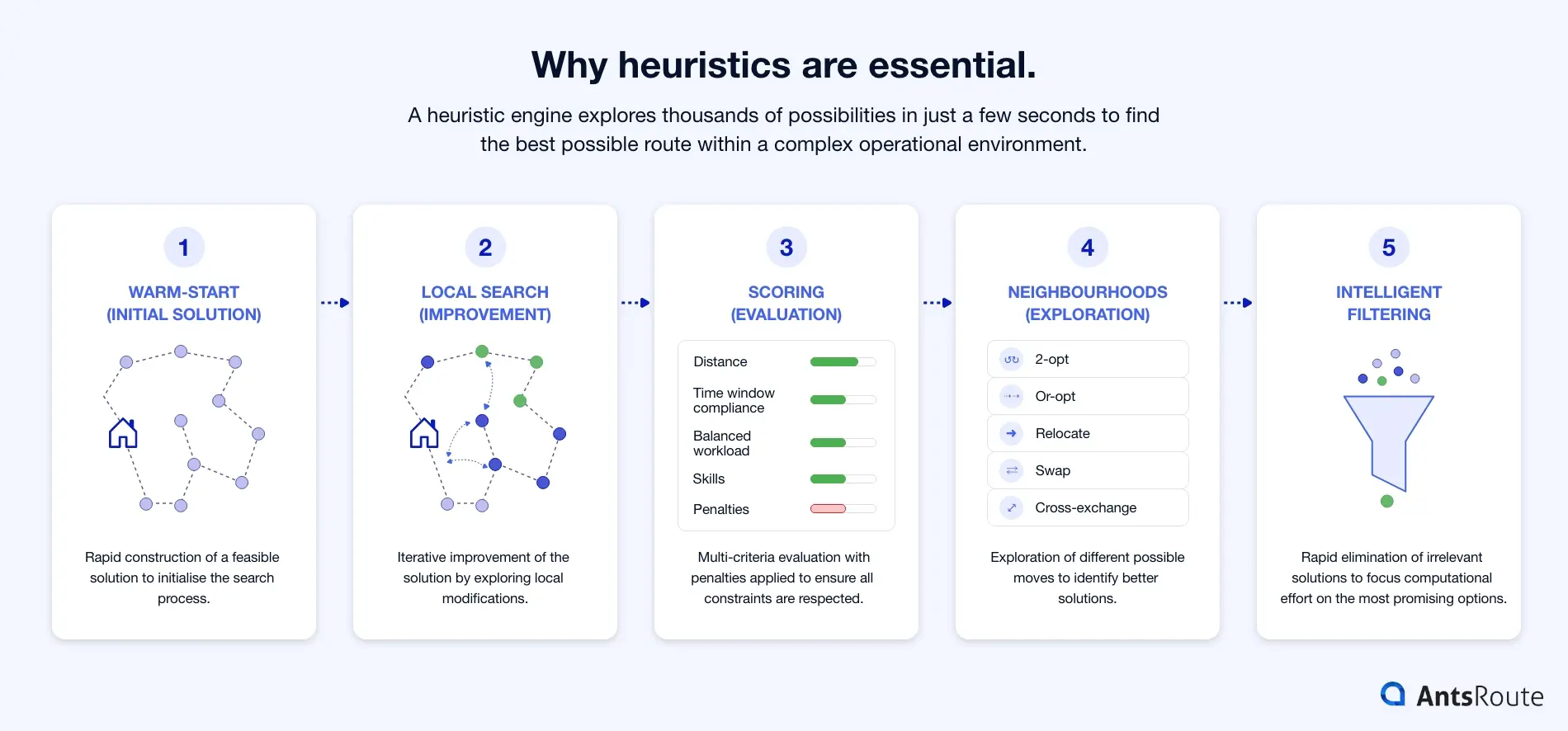
Modern heuristic engines use several complementary mechanisms — warm starts, local search, multi-criteria scoring and neighbourhood exploration — to rapidly evaluate thousands of solutions and optimise routes in highly constrained environments.
Behind the algorithms lies a very concrete objective
In many companies, operations teams still spend a significant part of their day manually reorganising routes.
This operational mental load is often underestimated.
And yet, it is precisely where a large part of field performance is determined:
- the ability to absorb unexpected events,
- responsiveness,
- service quality,
- schedule robustness,
- customer satisfaction,
- and cost control.
The objective of modern optimisation engines is therefore not simply to reduce mileage.
The real goal is to help teams make better decisions in an environment that is constantly changing and heavily constrained.
Conclusion
Route optimisation is often presented as a simple route calculation problem.
In reality, it is primarily a constant balancing act between:
- operational constraints,
- service quality,
- operational feasibility,
- route stability,
- and economic performance.
And the more operations evolve in real time, the greater this complexity becomes.
At AntsRoute, our approach is precisely about designing engines capable of adapting to this operational reality: systems able to intelligently evaluate every possible insertion while taking real-world operational constraints into account.
Because in last-mile logistics, the real challenge is not simply optimising a schedule.
It is continuing to make the right decisions when conditions in the field are constantly changing.
WRITTEN BY

Marie Henrion
At AntsRoute, Marie has been the marketing manager since 2018. With a focus on last-mile logistics, she produces content that simplifies complex topics such as route optimization, the ecological transition, and customer satisfaction.
Free 7-day trial | No credit card required
Contenu
- Behind a “simple” route lies an extremely complex mathematical problem
- The real challenge is not building a route… but adapting it intelligently
- Why traditional tools quickly reach their limits
- How our optimisation engine evaluates every possible insertion
- Why distance alone is never enough
- Time windows fundamentally change the problem
- Operational constraints are often the real core of the problem
- Why heuristics have become essential
- Behind the algorithms lies a very concrete objective
- Conclusion