Optimising plumbers’ routes: a key challenge to improve efficiency
Blog > Field Service > Optimising plumbers’ routes: a key challenge to improve efficiency
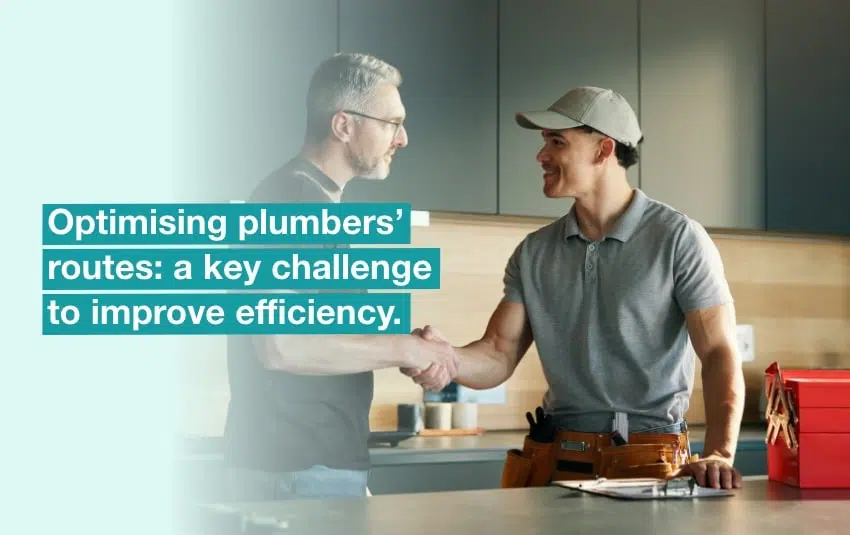
Optimising plumbers’ routes: a key challenge to improve efficiency
Published on 15 April 2026 • Reading time: 7 min read

A burst pipe to fix urgently at 8:30 am.
A boiler to replace at 10 am.
The phone keeps ringing for a blocked drain at midday.
In many plumbing businesses, this type of day is far from unusual. The job schedule evolves constantly, driven by unexpected events. What was planned on Monday morning rarely reflects the reality of the week.
Each plumber or heating engineer carries out several jobs per day, often urgent, with sometimes significant travel. Organising jobs therefore becomes a constant balancing act, directly impacting both profitability and service quality.
Table of contents:
- Why is scheduling a challenge in plumbing?
- The consequences of inefficient scheduling for plumbing and heating services
- How to optimise plumbers’ routes?
- What does route optimisation software bring to your plumbing business?
Why is scheduling a challenge in plumbing?
A sector under pressure, where every job counts
In the UK, the plumbing and heating sector is made up of thousands of businesses, most of them small companies or sole traders.
These businesses often operate with small teams and face a shortage of skilled labour, which increases the pressure on existing staff.
In this context, every job matters. Available time becomes a scarce resource that must be used as efficiently as possible.

Emergency jobs with unpredictable durations
If scheduling is so difficult to manage, it is because the job itself is inherently unstable. A large part of the activity relies on reactive work: fixing leaks, unblocking drains (sink, shower or toilet), replacing fixtures or repairing a faulty boiler.
These situations require a fast response, but their duration remains uncertain. What was expected to take thirty minutes can easily extend to several hours, depending on what is discovered on-site.
Skill and field constraints that complicate planning
Another challenge is the diversity of skills. Not all technicians can handle the same types of jobs.
Some specialise in heating systems, others in emergency repairs, and others in installation work.
A plumber may carry out different types of tasks in the same day, from unblocking a sink to repairing a leak or replacing a hot water system.
The schedule must therefore take into account these constraints, not just time slots.
Field conditions add another layer of complexity:
- in urban areas, traffic and parking issues slow down jobs
- in rural areas, distances become longer
In practice, a plumber or heating engineer often travels many miles per day.
Customer constraints must also be considered: fixed time slots, urgent requests, and sometimes missed appointments.
All these factors disrupt the initial organisation and turn daily scheduling into a real headache, far from a simple calendar to fill.
As a result, the plumber’s schedule is almost never fixed. It evolves throughout the day. A job taking longer than expected, a new emergency, or a client absence: each unexpected event forces a reorganisation.
For the planner or dispatcher, the role is less about optimisation and more about continuous adjustment, often under pressure and with incomplete information.
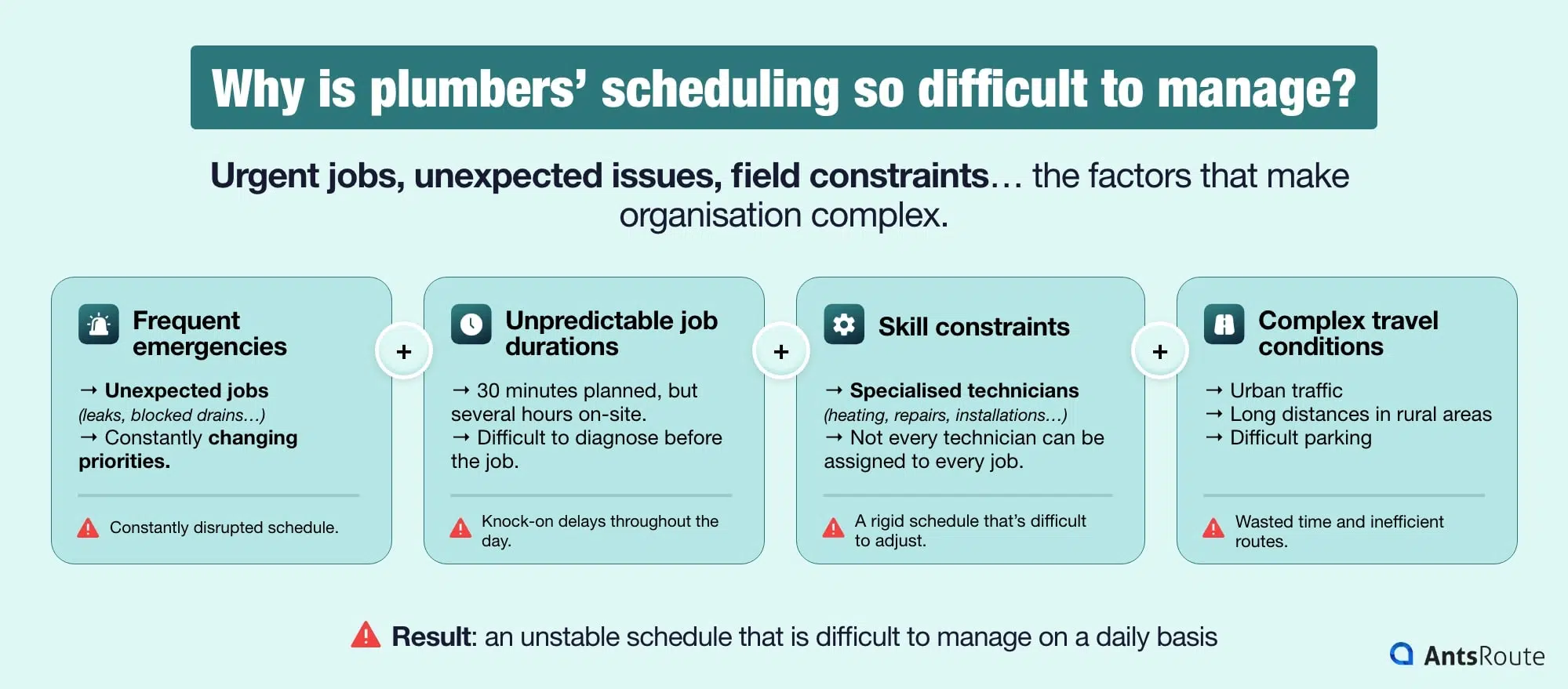
Plumbers’ schedules are constantly disrupted by emergencies, unpredictable job durations, field constraints and travel.
The consequences of inefficient scheduling for plumbing and heating services
When the schedule is not optimised, the impact is quickly felt across the entire business, both on costs and service quality.
General tools quickly reach their limits
You may be one of the many plumbing businesses using simple tools on a daily basis, such as spreadsheets, online calendars or simply the phone.
These solutions help manage day-to-day operations, but they quickly show their limits when the number of jobs increases or when unexpected events multiply.
In practice, information is scattered across multiple tools, with no global view of the schedule. New jobs become difficult to plan, especially in urgent situations.
In other words, these tools allow you to record jobs, but not to organise them efficiently.
Poorly structured routes increase costs
When organisation fails, the effects are immediate. Technicians spend more time on the road than with customers. Routes are not optimised, unnecessary trips increase, and some areas are covered multiple times in the same day.
These inefficiencies have a direct cost:
- wasted time
- increased mileage and fuel costs
- unused time slots
Over a day, this can represent the equivalent of one fewer job per technician.
A decline in service quality and customer satisfaction
Service quality is also affected. Customers lack visibility on appointment times, delays increase, and rescheduling becomes more frequent.
In a sector where responsiveness is essential, these issues quickly impact customer satisfaction and retention.
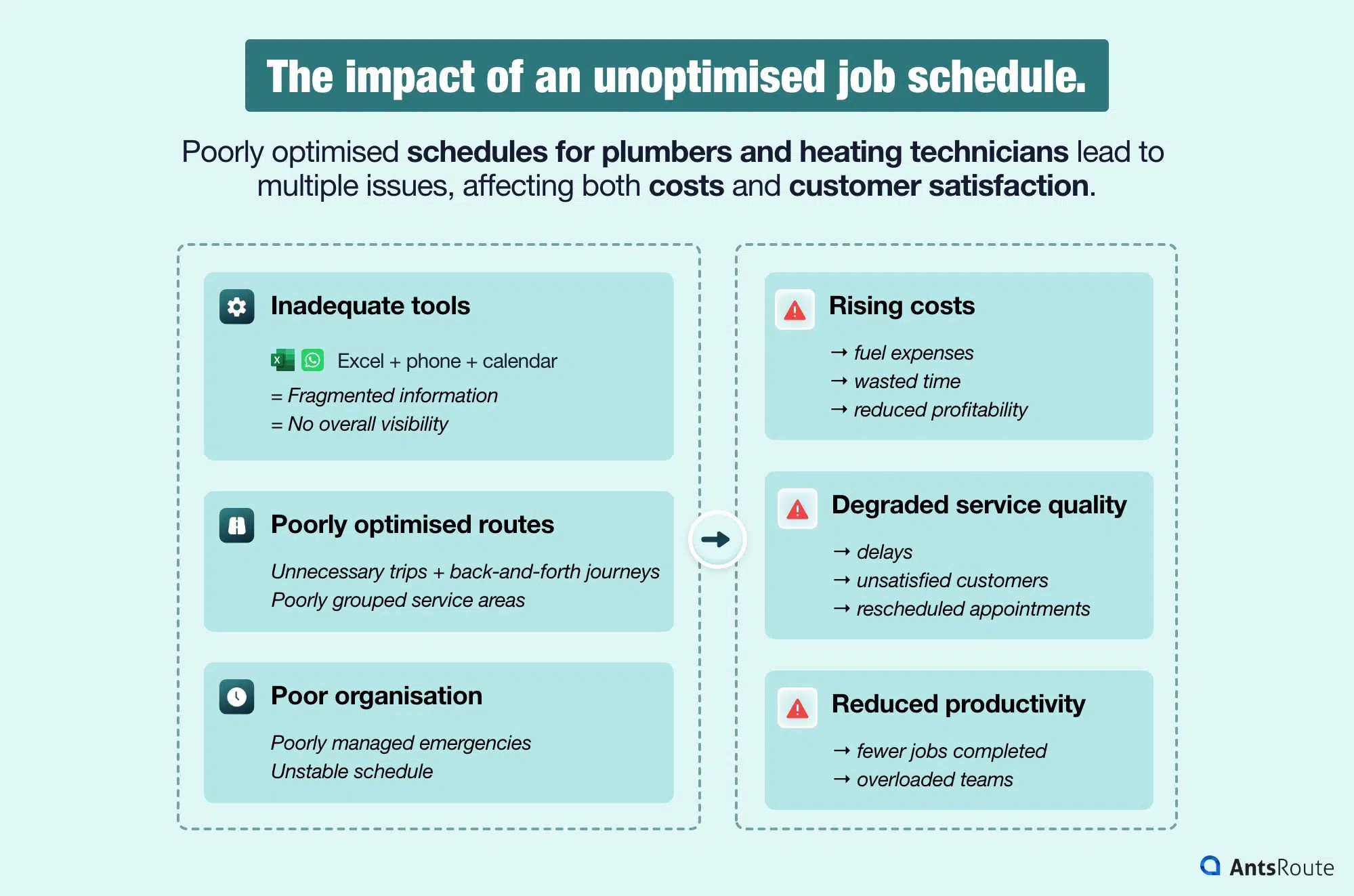
Inadequate tools and poorly organised routes quickly lead to higher costs, wasted time and reduced service quality for plumbing businesses.
How to optimise plumbers’ routes?
To sustainably improve organisation, it is necessary to change the approach and integrate field constraints from the very beginning of the planning process.
Centralising data to build efficient routes
Improving organisation is not just about filling a schedule, but about changing the way it is built.
It becomes necessary to centralise all information, integrate operational constraints and build coherent routes adapted to real-world conditions.
This is where route planning software becomes particularly relevant.
Integrating skills, constraints and urgency
These tools allow you to integrate in one place:
- job details and locations
- technician availability
- required skills
- customer constraints (time slots, equipment, etc.)
They can then generate an optimised schedule.
Concrete results: more jobs and fewer miles
Take the example of a plumbing business with eight technicians, carrying out around thirty jobs per day across a mixed urban and rural area.
Initially, scheduling was managed using a spreadsheet and numerous phone calls.
Common issues included delays, inefficient routes, missing equipment, high administrative workload and difficulty integrating urgent jobs.
By structuring its organisation and using a route optimisation tool, the company was able to better distribute jobs, reduce mileage and adjust schedules more easily throughout the day.
Results:
- time saved on planning
- smoother field operations
- fewer customer calls
- the ability to add one to two additional jobs per day
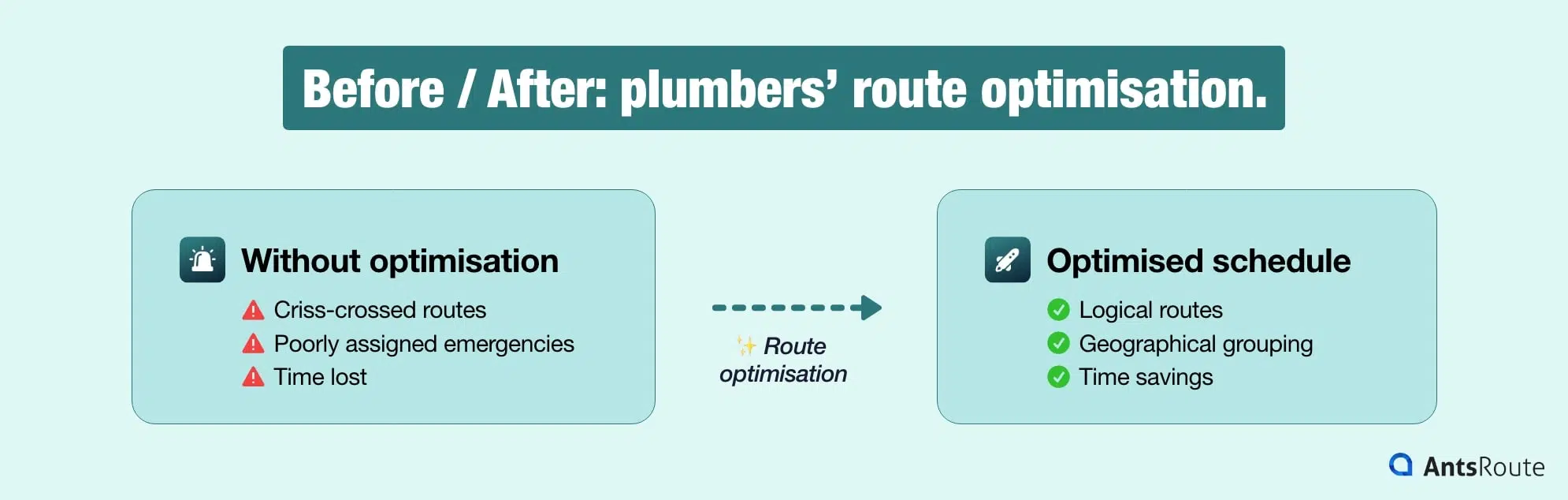
Before optimisation, routes are disorganised and lead to time loss. An optimised schedule helps structure travel and improve productivity.
What does route optimisation software bring to your plumbing business?
Using dedicated software makes it possible to structure routes efficiently and improve both operational performance and customer experience.
Automating scheduling and real-time tracking
These tools automate tasks that previously took a significant amount of time. Routes can be generated based on real constraints, technicians can be tracked in real time, and information flows more easily between office and field.
Customers can also be informed of arrival times, reducing missed appointments and improving service quality.
Reducing costs and increasing the number of jobs
Beyond organisational comfort, the impact is also financial. Better structured routes help to:
- reduce non-productive time
- reduce mileage and fuel costs
- increase the number of jobs completed with the same team
In a sector facing recruitment challenges, this is a major advantage.
Solutions like AntsRoute allow you to integrate all these parameters into a single tool, capable of optimising routes in seconds while remaining flexible.
Improving visibility and control
Better planning provides a clear view of operations.
You can:
- analyse job and travel times
- identify overloaded days
- reassign jobs based on location, skills and duration
Over time, this leads to fewer miles, less coordination time and a more structured organisation.
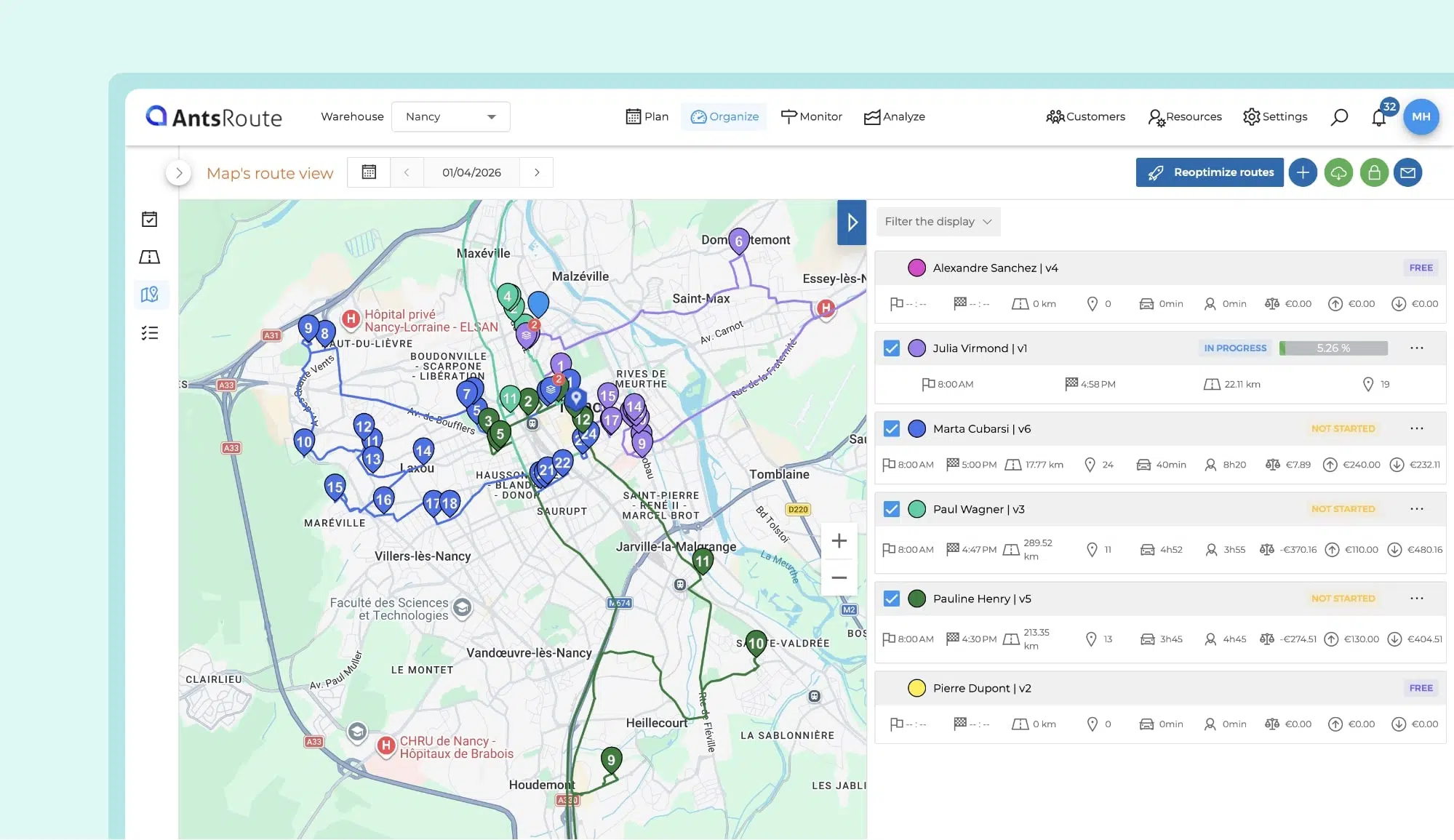
Building intervention routes for a team of 5 plumbers and heating engineers using AntsRoute.
Delivering reliable time slots and better responsiveness
For customers, the impact is just as significant. Better structured routes make it possible to:
- offer more reliable time windows,
- provide clearer information about arrival times,
- and reduce last-minute rescheduling.
In a sector where service quality also depends on punctuality and the ability to respond quickly, this can make a real difference.
This is exactly where software like AntsRoute brings real value. By centralising jobs in a single platform, automatically optimising routes based on defined constraints, and providing real-time visibility of operations, it helps businesses structure their organisation sustainably—without adding complexity or increasing the workload for teams.
WRITTEN BY

Maryline Lakh
Maryline worked for a major logistics company for 15 years. Since 2022, she has been an expert in communication and freelance writer for positive-impact logistics companies. She is passionate about new sustainable logistics solutions and writes for several clients, including AntsRoute.
Free 7-day trial | No credit card required
Contenu
- Why is scheduling a challenge in plumbing?
- A sector under pressure, where every job counts
- Emergency jobs with unpredictable durations
- Skill and field constraints that complicate planning
- The consequences of inefficient scheduling for plumbing and heating services
- General tools quickly reach their limits
- Poorly structured routes increase costs
- A decline in service quality and customer satisfaction
- How to optimise plumbers’ routes?
- Centralising data to build efficient routes
- Integrating skills, constraints and urgency
- Concrete results: more jobs and fewer miles
- What does route optimisation software bring to your plumbing business?
- Automating scheduling and real-time tracking
- Reducing costs and increasing the number of jobs
- Improving visibility and control
- Delivering reliable time slots and better responsiveness