Delivery note: definition, purpose and a complete guide for businesses (2026 edition)


The delivery note is one of those documents that every business uses, yet few truly leverage to its full potential. Long confined to an administrative role, it has become, in 2026, a structuring component of the operational and financial chain, connecting field deliveries, customer satisfaction and performance analysis.
In a context of rising volumes, increasing cost pressure and stricter traceability requirements, understanding and optimising the use of the delivery note is no longer optional. AntsRoute offers you a guide designed to provide a clear, modern and operational view of the topic.
☝️ Key takeaways
- The delivery note is no longer just an administrative document: today, it acts as a key link between field deliveries, logistics and performance management.
- When properly structured and clearly distinguished from other documents, it helps reduce errors, disputes and processing times, without directly triggering invoicing.
- When digitised and integrated into business tools, this delivery document becomes a valuable data source to secure operations and improve overall performance with AntsRoute.
Table of contents:
- What is a delivery note?
- The role of this delivery document within the business
- Content and compliance of a delivery note
- Delivery note: avoiding confusion
- Common mistakes around this logistics document
- Paper or digital delivery notes in 2026
- 2026 trends around the delivery note
- Optimising delivery note management
What is a delivery note?
A delivery note (DN) is a commercial document issued by a supplier when goods are handed over or a service is carried out at a customer’s premises. It confirms that the delivery has taken place on a specific date and for defined quantities.
In practical terms, a delivery note is used to:
- confirm the effective handover of products or services,
- formally record the quantities delivered,
- document any reservations or remarks raised by the customer,
- serve as a shared reference point between teams.
This document accompanying the goods therefore constitutes a central link between:
- field teams,
- logistics,
- sales administration,
- and finance.
It formalises the execution of a commercial commitment without triggering payment, and therefore does not constitute an invoicing document.
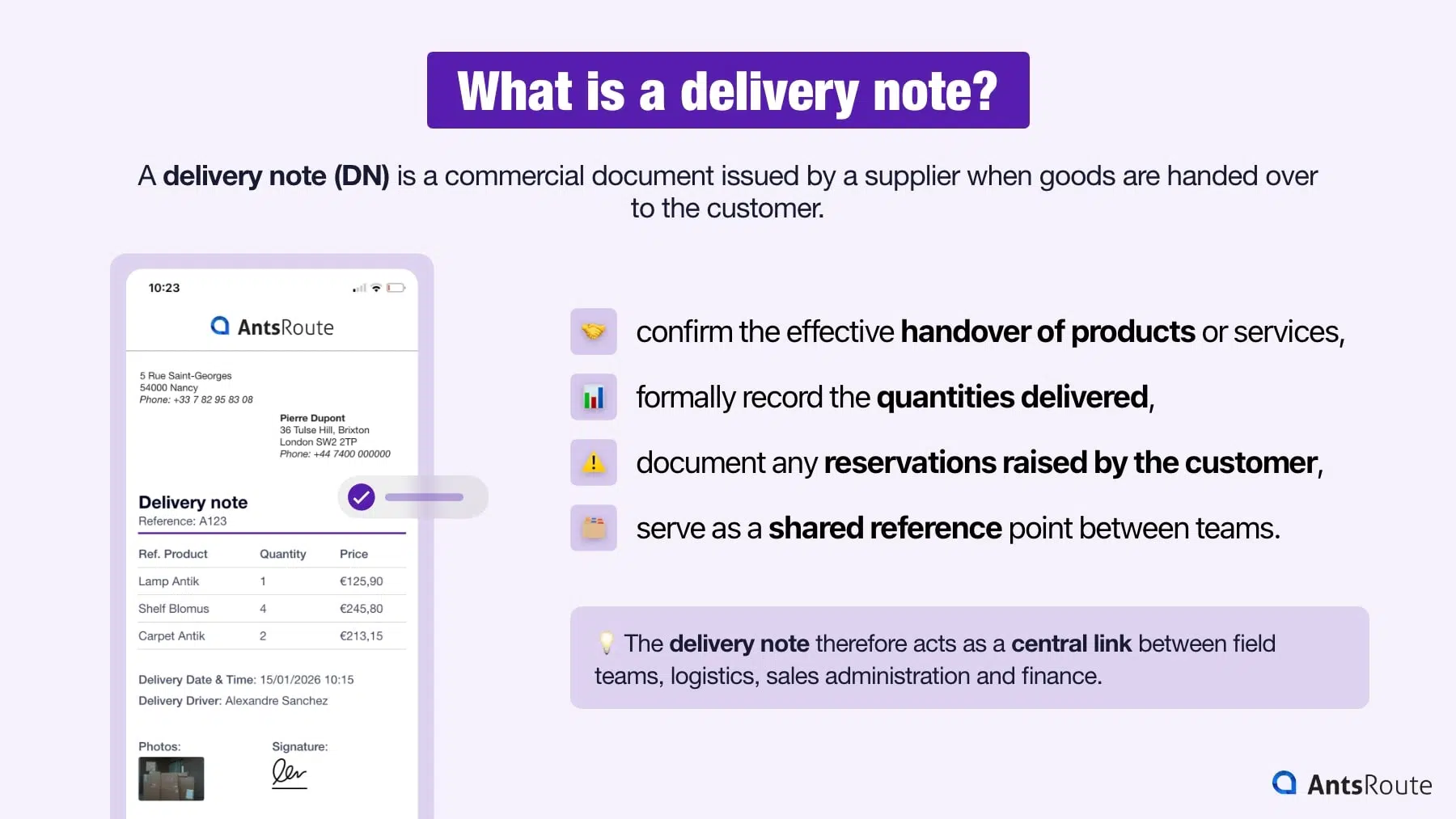
The key objectives of a delivery note.
The role of this delivery document within the business
Field operations and customer relationship
In the field, the delivery note remains a central tool for delivery and service teams. It confirms that the planned task has been successfully completed and that it meets the customer’s expectations.
In last-mile delivery and field service activities, it helps to:
- improve customer satisfaction,
- reduce disputes and misunderstandings,
- streamline communication between the field and the back office,
- secure the customer relationship after the job has been completed.
In this context, the delivery note fully forms part of a delivery route optimisation approach, by providing better visibility into the actual execution of jobs and on-the-ground contingencies.
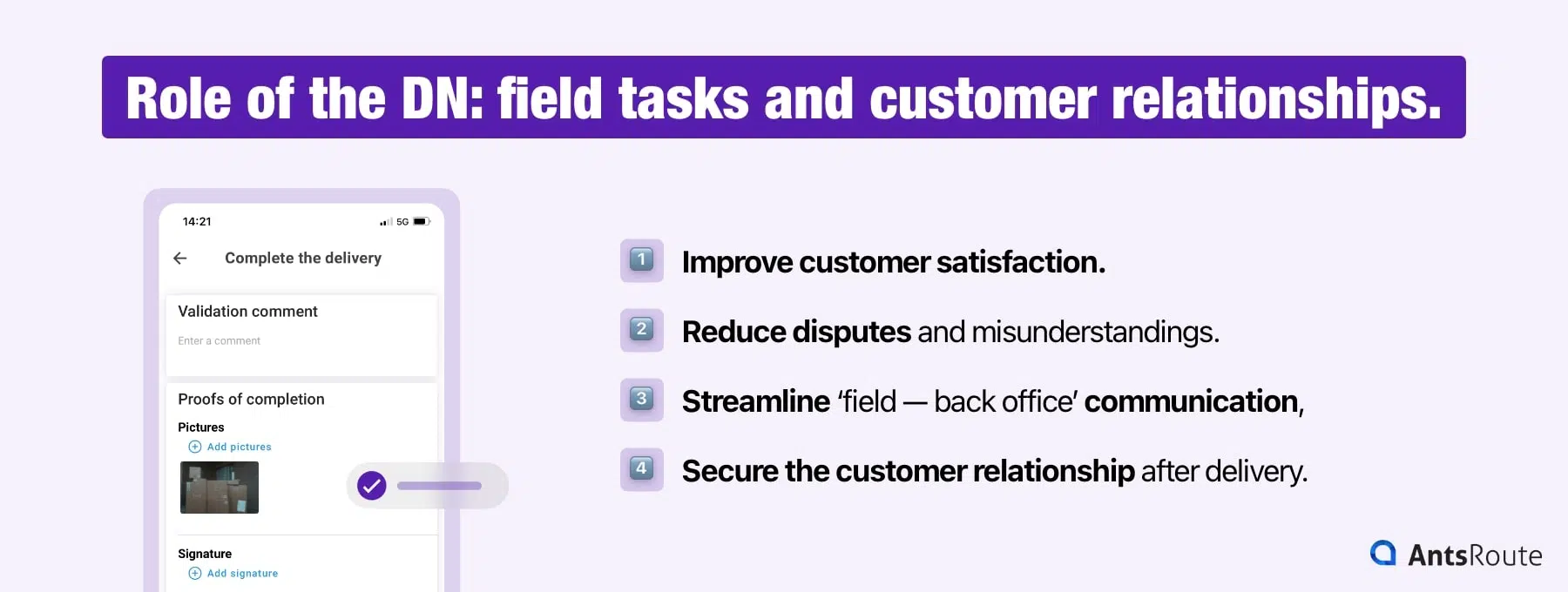
The role of the delivery note in field operations and customer relationships.
Logistics and supply chain
From a logistics perspective, the delivery note connects warehouse preparation with field execution. It plays a key role in controlling outbound flows.
In particular, it helps to:
- verify consistency between goods prepared and goods delivered,
- ensure reliable stock updates,
- track logistics flows,
- detect differences more quickly.
When properly structured and integrated into logistics tools, it becomes an essential control point for operational quality.
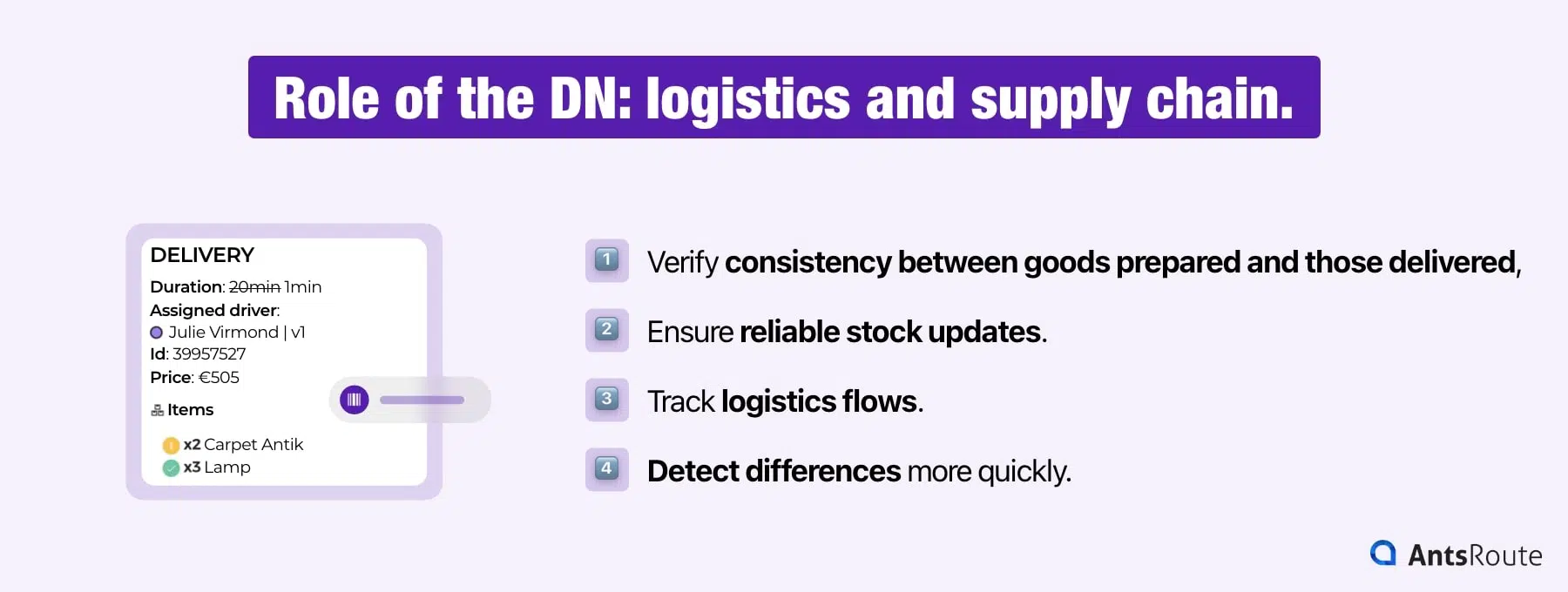
The role of the delivery note in logistics and the supply chain.
Finance and management control
From a finance perspective, the delivery note is a key link in the order – document signed by the customer – invoice reconciliation process.
It represents an essential data source for:
- ensuring reliable revenue recognition,
- accelerating the Order-to-Cash cycle,
- reducing commercial disputes,
- securing the closing of accounts.
| Axis | Operational use | Analytical use |
| Purpose | Confirm delivery | Manage performance |
| Stakeholders involved | Field teams, customers | Finance, management control |
| Key data | Date, quantities, reservations | Lead times, variances, costs |
| Value created | Customer satisfaction | ROI and cash flow |
When used effectively, a delivery note makes it possible to move from a purely administrative approach to a performance management mindset.
Content and compliance of a delivery note
A delivery note that can be effectively used must contain a number of key pieces of information so that it can be clearly understood and used by all stakeholders.
It typically includes:
- identification of the supplier and the customer,
- the delivery date and location,
- a description of the products or services delivered,
- the quantities expected and actually delivered,
- any reservations or observations noted.
The customer’s signature, while not systematically mandatory, is strongly recommended in order to:
- limit disputes,
- secure commercial exchanges,
- facilitate administrative and financial processing.
Delivery note: avoiding confusion
The delivery note is often confused with other logistics or commercial documents. This confusion can lead to process errors, disputes or invoicing delays. It is therefore essential to clearly distinguish the role of each document.
| Document | Primary role | Point of use | Scope |
| Delivery note | Confirmation of handover | At delivery | Operational |
| Proof of delivery | Formal validation of handover | At / after delivery | Legal & evidential |
| Packing list | Detailed contents | Preparation | Logistics |
| Transport invoice | Transport billing | After delivery | Financial |
| Customer invoice | Triggers payment | After validation | Accounting |
Each document serves a specific purpose and should not be used as a substitute for another.
Common mistakes around this logitics document
Despite its apparent simplicity, the delivery note is the source of many operational errors. These usually stem from improper use of the document rather than from the document itself.
One of the most common mistakes is treating it as a mere piece of paperwork with no impact beyond the field. When it is incomplete, poorly filled in or badly archived, it slows down invoicing and makes performance management more complex.
Confusion with other documents, excessive reliance on paper, or a lack of integration with business tools are also frequent sources of friction. In such cases, this delivery document becomes a constraint, when it could instead be a real performance lever.

Paper or digital delivery notes in 2026
The digitisation of delivery notes has become firmly established. In 2025-2026, more than two thirds of European logistics companies have launched a delivery document digitalisation initiative, with measurable improvements in both operational and financial performance.
| Criteria | Paper delivery note | Digital delivery note |
| Processing time | Slow | Instant |
| Data entry errors | High | Very low |
| Traceability | Limited | Real time |
| Data utilisation | Almost non-existent | High |
| ERP / accounting integration | Manual | Automatable |
Companies that have adopted digital delivery notes typically see, on average:
- shorter invoicing lead times,
- fewer customer disputes,
- a reduction in data re-entry errors.
2026 trends around the delivery note
In 2026, the delivery note is evolving into a natively digital document, validated in real time on mobile devices, integrated with ERP systems and leveraged as an analytical data source. It now feeds dashboards used to track service levels, logistics variances and the time between delivery and invoicing.
This shift is transforming the delivery document into a decision-making lever, well beyond its historical role as a simple confirmation document.
Optimising delivery note management
The most high-performing companies centralise their delivery notes within a single tool, in order to avoid information silos and manual re-entry. This centralisation ensures data reliability from the field onwards and guarantees smooth handovers between operational, logistics and finance teams.
In this context, specialised solutions such as AntsRoute make it possible to structure delivery document management within a coherent ecosystem. The objective is not merely to digitise the document, but to embed it within an end-to-end process that connects field execution, route planning and operational management.
By linking delivery notes to logistics, finance and performance monitoring tools, businesses reduce operational friction, speed up administrative processing and secure the key stages of the order–delivery–invoicing cycle. The delivery note then becomes a true performance management lever, rather than a simple validation document.
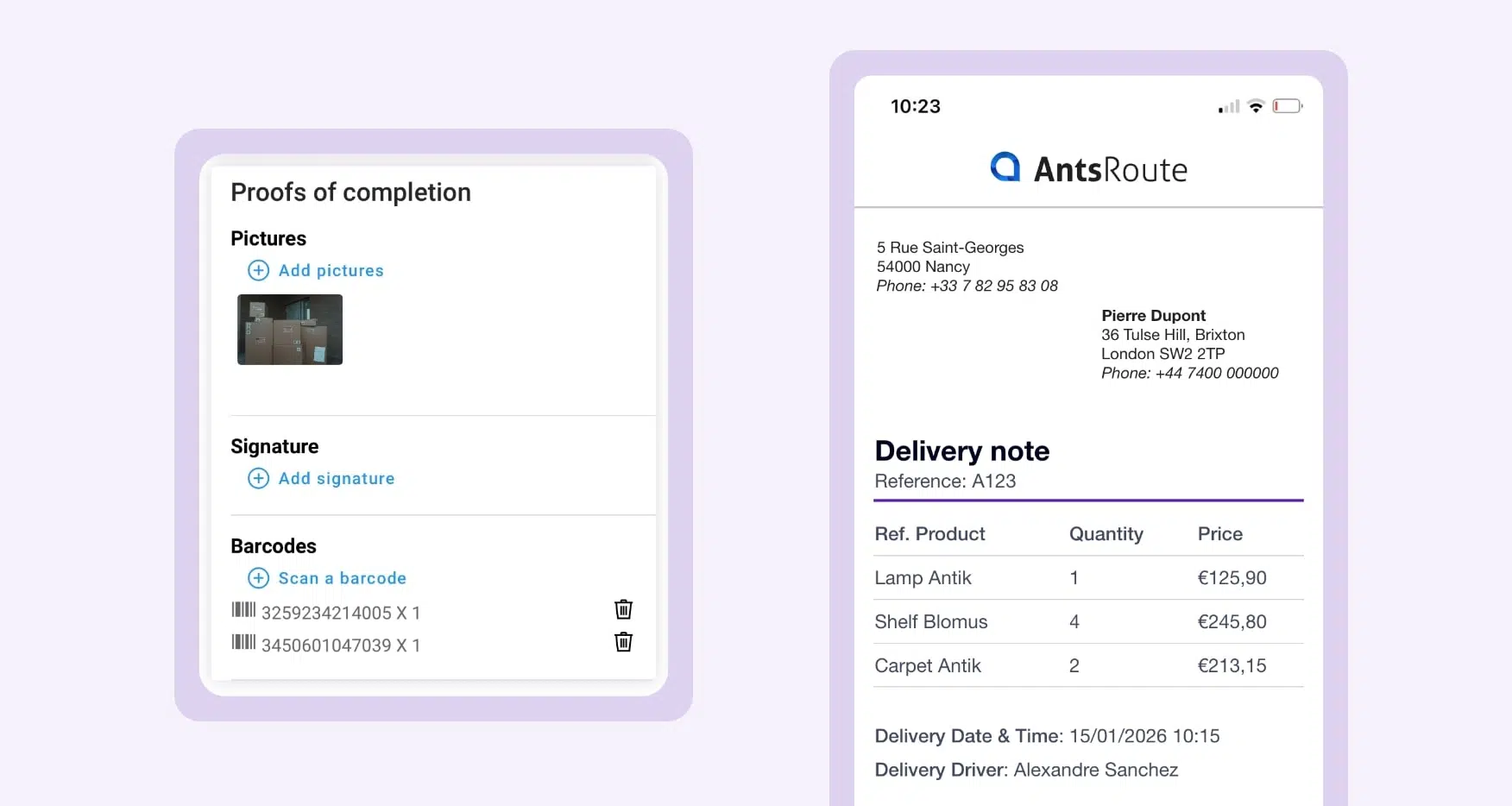
The collection of proof of delivery and the creation of delivery notes with AntsRoute.
In 2026, the delivery note has become a point of convergence between field operations, logistics and financial performance management. Companies that digitise it and use it intelligently gain in reliability, visibility and profitability.
To go further, solutions such as AntsRoute make it possible to connect delivery management, field teams and analytical data within a single ecosystem.
Looking to simplify the management of your logistics documents, reduce field errors and strengthen the link between delivery, invoicing and performance management?
➡️ Request a personalised AntsRoute demonstration
➡️ Try AntsRoute free for 7 days
FAQ: Delivery note
No, it is not legally mandatory in all cases, but it is strongly recommended to secure commercial exchanges and limit disputes.
It has limited evidential value. It primarily serves as operational proof and can support a case in the event of a dispute, without replacing an invoice or a contract.
In practice, between five and ten years, depending on the accounting, tax and sector-specific obligations applicable to the business.
The delivery note confirms that products or services have been handed over, while the proof of delivery provides formal validation, often used in the event of disputes or for invoicing purposes.
Yes. In 2026, delivery notes are increasingly digitised to reduce errors, speed up invoicing and improve delivery traceability.
No, it does not directly trigger invoicing, but it is a key step in the order–delivery–invoice process.
WRITTEN BY

Marie Henrion
At AntsRoute, Marie has been the marketing manager since 2018. With a focus on last-mile logistics, she produces content that simplifies complex topics such as route optimization, the ecological transition, and customer satisfaction.
Free 7-day trial | No credit card required
Contenu
- What is a delivery note?
- The role of this delivery document within the business
- Field operations and customer relationship
- Logistics and supply chain
- Finance and management control
- Content and compliance of a delivery note
- Delivery note: avoiding confusion
- Common mistakes around this logitics document
- Paper or digital delivery notes in 2026
- 2026 trends around the delivery note
- Optimising delivery note management
- FAQ: Delivery note